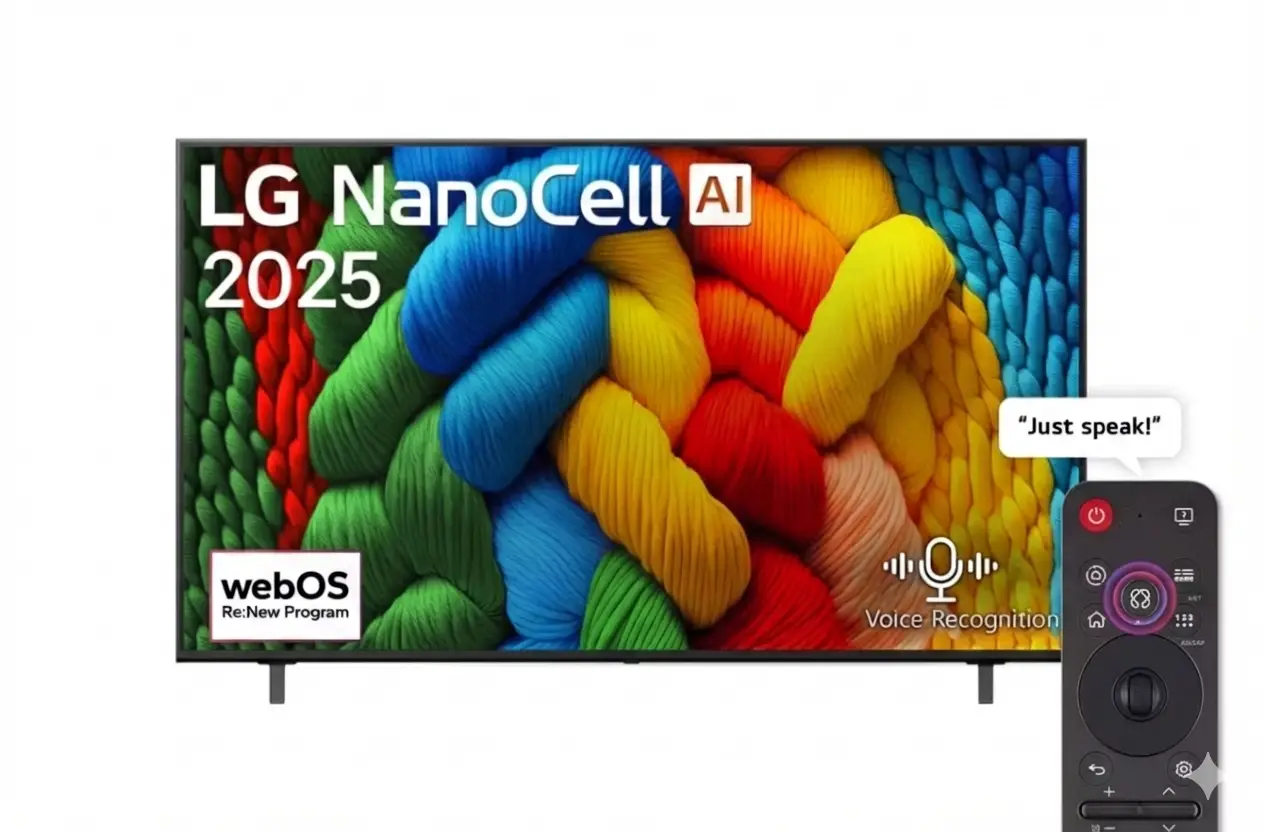
🎨 86″ NANOCELL AI SMART TV!
α7 Gen8 Processor | webOS 25 AI | HDR10 | HGiG Gaming | Virtual 9.1.2 Audio
LG 86NANO80A6A NanoCell AI 4K Smart TV
86″ Ultra Big | α7 Gen8 AI | webOS 25 | Voice ID | Home Hub
NanoCell – Pure Colors – 4K Super Upscaling – AI Magic Remote
🎨 86″ NanoCell AI Consumer Display!
86″ Ultra Big Screen: 1927×1104mm viewable area
NanoCell Technology: Pure vivid colors in real 4K
α7 AI Processor Gen8: 4K upscaling & AI features
webOS 25: AI Voice ID, AI Search, AI Chatbot
Gaming: HGiG, Game Optimizer, ALLM, VRR 60Hz
Audio: AI Sound Pro Virtual 9.1.2 channels
Smart Home: Home Hub with Matter support
Consumer Grade: Full smart TV platform
₹1,95,899-2,25,000
ConsumerModel: 86NANO80A6A | MRP ₹3,68,740 (46% discount) | Best: Flipkart ₹1,95,899
🏠 86″ CONSUMER SMART TV WITH AI!
Flagship 86-inch consumer NanoCell display designed for large living rooms featuring pure color technology, α7 AI Processor Gen8 intelligence providing 4K upscaling, revolutionary webOS 25 with AI Voice ID recognizing individual users offering personalized recommendations, AI Search with Microsoft Copilot integration, AI Chatbot troubleshooting, AI Concierge customized content discovery creating intelligent entertainment hub. Excellent gaming features include HGiG Mode (HDR Gaming Interest Group certified game-accurate HDR), Game Optimizer Dashboard with FPS/RPG/RTS/Sports presets, ALLM auto gaming detection, VRR up to 60Hz smoothness. Home Hub platform seamlessly manages LG ThinQ appliances alongside Google Home and Matter-compatible devices through single intuitive dashboard. FILMMAKER MODE preserves director’s intent. AI Sound Pro Virtual 9.1.2 creates surround experience from 2.0CH 20W speakers. webOS Re:New Program provides 5 years upgrades!
🇮🇳 India
₹1,95,899-2,25,000
Flipkart, Croma, Vijay Sales, Amazon, LG Store
🌍 Middle East (Levant)
Contact Retailers
UAE, Saudi Arabia, Qatar, Egypt available
🌏 Other Markets
USA: $2,299-2,799 | Australia: AU$3,499-4,299 | Europe: €2,199-2,699 (estimated)
| Size | India Price |
|---|---|
| 55″ (55NANO80A6A) | ₹63,999 |
| 65″ (65NANO80A6A) | ₹1,09,499 |
| 75″ (75NANO80A6A) | ₹92,990 |
| 86″ (86NANO80A6A) ⭐ | ₹1,95,899 |
Screen Size
86″ (218cm)
Processor
α7 Gen8 AI
Platform
webOS 25
LG 86NANO80A6A Complete Overview
🎨 NanoCell Technology
- Nano Color: Pure vivid colors in real 4K
- Color Accuracy: Nano-particle wavelength filtering
- Wide Color Gamut: Rich, vibrant colors
- 4K Detail: Astounding visual clarity
- Wide Viewing Angle: Consistent colors off-axis
- HDR10 Pro: Enhanced HDR processing
- Dynamic Tone Mapping: Scene optimization
- 10 Picture Modes: Versatile presets
🧠 α7 AI Processor Gen8
- ✓ 4K Super Upscaling: AI enhancement
- ✓ AI Brightness Control: Scene optimization
- ✓ AI Picture Wizard: 1.6B possibilities
- ✓ AI Sound Wizard: 40M parameters
- ✓ Faster Processing: Gen8 improvements
- ✓ Deep Learning: Neural networks
🤖 webOS 25 AI
- AI Voice ID: Personalized per user
- AI Search: Microsoft Copilot integration
- AI Chatbot: Troubleshooting assistant
- AI Concierge: Content recommendations
- Home Hub: Smart home control
- webOS Re:New: 5 years upgrades
🏠 What Makes 86NANO80A6A the Premium Consumer Smart TV?
The LG 86NANO80A6A represents flagship consumer smart TV experience – ₹1,95,899-2,25,000 positioning targets large living rooms in spacious Indian homes (1,500-2,500 sq ft) with 18-22 feet viewing distances where 86″ screen creates theater-like immersive entertainment experience impossible from smaller 65-75″ displays. Unlike budget 86″ alternatives lacking advanced features, 86NANO80A6A combines NanoCell color technology, α7 AI Processor Gen8 intelligence, revolutionary webOS 25 AI platform creating premium home entertainment hub justifying investment through superior picture quality, gaming capabilities, smart features versus basic large displays offering only size without performance.
The NanoCell technology delivers pure color accuracy with vivid richness – nano-meter-sized particles filter impure RGB wavelengths eliminating color muddiness creating pure, accurate colors paired with astounding 4K detail. Traditional LED panels without NanoCell technology produce washed-out colors especially at wide viewing angles where color shifts visible. NanoCell maintains color consistency across entire viewing area enabling multiple family members viewing from different positions experiencing accurate colors versus traditional panels where off-axis viewers see degraded color accuracy frustrating shared viewing experiences typical of family entertainment where not everyone sits directly center.
The α7 AI Processor Gen8 delivers significant performance improvements – eighth-generation processor features faster processing speeds, enhanced neural network capabilities, improved upscaling algorithms versus Gen7 (2024 models) creating measurable picture quality advantages. 4K Super Upscaling converts HD cable channels, 1080p streaming content, standard definition sources to near-4K quality using AI neural networks trained on billions of images recognizing patterns reconstructing missing pixels creating sharp detailed picture from lower-resolution sources. AI Brightness Control analyzes each scene adjusting brightness optimally adapting to room lighting conditions. Dynamic Tone Mapping provides frame-by-frame HDR optimization maximizing limited peak brightness creating impressive HDR presentation despite lacking ultra-bright panel specifications.
The webOS 25 introduces revolutionary AI personalization features – AI Voice ID recognizes individual family member’s unique voice signatures offering personalized content recommendations matching each person’s viewing preferences automatically switching profiles when different users speak. AI Search with Microsoft Copilot integration enables natural language queries providing intelligent answers beyond simple content search (“What movies won Oscars last year?”) delivering contextual information impossible from basic voice search limited to app/title matching. AI Chatbot provides troubleshooting assistance answering configuration questions, solving technical issues through conversational interface eliminating frustrating manual searches through settings menus typical of complex smart TVs.
The gaming features rival dedicated gaming displays – HGiG Mode (HDR Gaming Interest Group certified) provides game-accurate HDR tone mapping communicating TV’s brightness capabilities to PlayStation 5/Xbox Series X enabling console to perform appropriate tone mapping matching game developer’s artistic intent versus traditional HDR modes applying cinematic curves inappropriate for game content. Game Optimizer Dashboard provides quick-access overlay displaying FPS, RPG, RTS, Sports, Standard presets optimizing picture parameters for different game genres. ALLM (Auto Low Latency Mode) automatically detects gaming console activating Game mode reducing input lag. VRR (Variable Refresh Rate) up to 60Hz eliminates screen tearing creating smooth gaming experience competitive with dedicated gaming monitors at fraction of cost.
The Home Hub platform provides comprehensive smart home control – seamlessly manage LG ThinQ appliances (refrigerators, washing machines, air conditioners, air purifiers) alongside Google Home devices and Matter-compatible smart home products through single intuitive TV dashboard. Monitor washing machine status, adjust air conditioner temperature, check refrigerator contents, control smart lights without switching apps or grabbing smartphone. 86″ display creates perfect smart home command center replacing need for dedicated smart displays providing comprehensive control impossible from smartphone-only interfaces requiring constant device unlocking and app switching frustrating smart home management.
NanoCell Technology – Pure Colors in Real 4K
🎨 How NanoCell Technology Works
The NanoCell technology uses nano-meter-sized particles filtering impure light wavelengths – traditional LED backlights emit broad-spectrum light containing impure wavelengths creating color contamination where reds appear orange-tinted, blues appear cyan-shifted, greens appear yellow-muddied reducing color purity and vividness. NanoCell layer positioned behind LCD panel contains nano-particles (approximately 1 nanometer size) absorbing specific impure wavelengths allowing only pure red, green, blue wavelengths passing through creating accurate vivid colors eliminating muddiness typical of standard LED displays. Physics principle similar to polarizing filters removing unwanted light creating cleaner final image.
The wide color gamut coverage enables vivid color reproduction – NanoCell filtering expands displayable color space beyond standard LED panels accessing wider range of visible colors matching or exceeding DCI-P3 cinema color standards versus sRGB limited color space of budget displays. Vivid saturated colors appear rich and vibrant without oversaturation creating natural-looking picture maintaining color accuracy. Skin tones appear natural, landscapes show lush greens and deep blues, food content displays appetizing colors creating engaging viewing experience across content types impossible from narrow color gamut displays producing washed-out dull colors requiring excessive saturation adjustments causing unnatural over-processed appearance.
🌈 Color Accuracy Benefits
Wide Viewing Angle Performance
The NanoCell maintains color consistency at wide viewing angles – traditional VA panels suffer severe color shift and brightness degradation when viewed off-axis creating poor experience for viewers sitting sides versus center position. NanoCell combined with IPS-type panel technology maintains color accuracy and brightness consistency across approximately 178-degree viewing angles enabling entire family viewing from different positions experiencing similar picture quality. Critical for large living rooms where 86″ screen viewed by multiple people simultaneously positioned at various angles requiring consistent picture quality across viewing positions versus center-only optimization.
Content Type Optimization
- Movies/TV Shows: Accurate director-intended colors maintaining artistic vision
- Sports: Vivid team colors, lush grass greens, realistic skin tones
- Nature Documentaries: Rich landscape colors, vibrant wildlife plumage
- Gaming: Accurate game world colors matching developer intent
- Food Content: Appetizing accurate food colors enhancing visual appeal
- Animation: Vibrant saturated colors enhancing animated content
Real-World Impact: Watching nature documentary featuring tropical birds, NanoCell displays vibrant plumage colors (reds, blues, greens, yellows) with purity and richness impossible from standard LED creating immersive experience matching documentary filmmaker’s captured reality versus washed-out colors requiring manual saturation increases causing unnatural over-processed appearance destroying subtle color gradations.
📺 4K Detail Enhancement
Resolution Clarity
The 3,840 × 2,160 resolution provides 8.3 million pixels – four times Full HD resolution creating exceptional detail clarity visible on large 86″ screen where pixel density sufficient preventing visible pixelation at typical 18-22 feet viewing distances. Native 4K content (Ultra HD Blu-ray, Netflix 4K, Disney+ 4K, Amazon Prime 4K) displays stunning detail showing fabric textures, facial pores, background minutiae creating lifelike picture impossible from 1080p displays where interpolation visible on large screens. 86″ size makes 4K resolution necessary versus smaller displays where 1080p adequate creating appropriate resolution-size pairing.
Upscaling Performance
α7 Gen8 processor upscales HD content to near-4K quality – majority of Indian broadcast television remains HD 1080i/720p requiring upscaling to 4K display resolution. Gen8 AI algorithms analyze content patterns using neural networks trained on billions of images intelligently reconstructing missing pixels creating sharper detailed picture versus simple pixel duplication producing soft blurry appearance. Cable news channels, sports broadcasts, HD streaming content benefits from sophisticated upscaling maintaining watchability on massive 86″ screen where HD content normally appears soft creating viewing versatility across content sources.
Viewing Distance Calculation: 86″ diagonal optimal viewing distance = 1.5-2.0× diagonal for 4K content = 129-172 inches = 10.7-14.3 feet. Closer distances (8-10 ft) provide immersive field-of-view, farther distances (16-22 ft) provide comfortable relaxed viewing. NanoCell color purity maintains picture quality across entire distance range versus displays with color accuracy issues appearing degraded at various viewing positions.
🎨 HDR10 Pro – Enhanced HDR Processing
The HDR10 Pro technology developed by LG enhances standard HDR10 content – while 86NANO80A6A lacks flagship Dolby Vision support found in premium OLED models, HDR10 Pro processing optimizes standard HDR10 and HLG (Hybrid Log Gamma) content through LG’s proprietary algorithms. Dynamic Tone Mapping analyzes each scene adjusting tone mapping curves optimizing for TV’s brightness capabilities (estimated 300-400 nits peak) creating improved HDR presentation versus static tone mapping applying single curve to entire content causing suboptimal brightness distribution where some scenes too dark or highlights blown out.
The scene-by-scene optimization maximizes perceived HDR impact – dim indoor scenes receive different tone mapping than bright outdoor scenes optimizing each independently. Dark dungeon game scene preserves shadow detail without crushing blacks while maintaining highlight visibility. Bright beach scene controls highlights preventing blown-out sky while maintaining vibrant colors. Frame-by-frame analysis ensures smooth transitions avoiding abrupt brightness changes disturbing viewing experience. Creates impressive HDR presentation despite modest peak brightness specifications rivaling more expensive alternatives through intelligent processing compensating hardware limitations.
Supported HDR Formats:
- HDR10: Universal HDR standard supported all streaming services
- HLG (Hybrid Log Gamma): Broadcast HDR standard for live TV
- HDR10 Pro: LG proprietary enhanced processing
- Dynamic Tone Mapping: Scene-by-scene optimization
- NOT Supported: Dolby Vision, HDR10+, HDR10+ Adaptive
HDR Content Sources: Netflix, Amazon Prime Video, Disney+, Apple TV+, YouTube all stream HDR10 content accessible on 86NANO80A6A. Ultra HD Blu-ray discs (via external player connected HDMI) provide highest-quality HDR10 content. PlayStation 5 and Xbox Series X games output HDR10 gaming content optimized through HGiG Mode. Lack of Dolby Vision not critical limitation as HDR10 universal format ensures broad content compatibility versus Dolby Vision limited to specific streaming services and premium content.
α7 AI Processor 4K Gen8 – Intelligence Powering Performance
🧠 What is α7 AI Processor Gen8?
The α7 (Alpha 7) AI Processor 4K Gen8 represents LG’s mid-premium processor tier – positioned between entry-level α5 processors (budget UR series) and flagship α9/α11 processors (OLED premium models), α7 Gen8 delivers advanced picture processing capabilities at accessible price point. “Gen8” indicates eighth-generation evolution featuring significant performance improvements versus Gen7 (2024 models) including faster processing speeds enabling real-time 60fps analysis, enhanced neural network capabilities improving AI accuracy, refined upscaling algorithms creating sharper reconstructed images, better HDR tone mapping extracting maximum quality from limited brightness specifications.
The AI and deep learning form processor’s core intelligence – neural networks trained on billions of reference images enable processor recognizing patterns in content applying appropriate enhancement techniques. Upscaling HD content to 4K requires intelligent pixel reconstruction beyond simple interpolation – processor identifies edges, textures, faces, text applying targeted sharpening preserving natural appearance versus artificial over-sharpened look. Noise reduction algorithms separate signal from compression artifacts removing ugliness while preserving fine details. Brightness optimization adapts to scene content and ambient room lighting. Creates “smart” processing adapting to content versus fixed-parameter processing applying identical treatment regardless of content type.
⚡ Processing Capabilities
4K Super Upscaling
The AI upscaling reconstructs lower-resolution content to near-4K quality – majority of content sources remain below native 4K resolution (cable HD broadcasts, streaming services at 1080p due to bandwidth limitations, DVD/Blu-ray collections, user-generated content) requiring sophisticated upscaling maintaining picture quality on 86″ 4K display. Gen8 neural networks analyze each frame identifying content types (faces, text, landscapes, motion) applying appropriate enhancement techniques. Sharpening algorithms enhance edges without introducing halos. Texture synthesis reconstructs fine details missing from source. Creates significantly better upscaled picture than simple pixel duplication producing soft muddy appearance typical of basic upscaling.
AI Brightness Control
Scene-by-scene brightness optimization adapts to content and environment – processor analyzes each scene’s average picture level adjusting backlight intensity optimally. Dark movie scenes reduce brightness preventing excessive light output in dim room. Bright sports content increases brightness ensuring visibility. Ambient light sensor detects room lighting conditions compensating automatically – bright sunny afternoon increases TV brightness maintaining visibility, evening dim lighting reduces brightness preventing eye strain. Creates optimal viewing experience across varying content and environment conditions versus static brightness settings requiring manual adjustments throughout day.
Processing Speed Improvements: Gen8 features faster processing enabling real-time 60fps content analysis versus Gen7 limited to 30fps processing requiring frame skipping. Faster processing reduces latency important for gaming ALLM responsiveness. Enhanced processing power enables more sophisticated algorithms running simultaneously (upscaling + noise reduction + motion processing + HDR tone mapping) without frame drops creating smooth consistent picture impossible from slower processors forcing processing compromises.
🎨 AI Picture & Sound Wizards
AI Picture Wizard – Personalized Calibration
The AI Picture Wizard learns individual viewing preferences through interactive selection – setup wizard displays pairs of images with subtle differences (brightness, contrast, saturation, sharpness, color tone variations), user selects preferred image from each pair, AI analyzes selections identifying preference patterns from 1.6 billion possible combinations creating personalized picture profile matching user’s visual preferences. Eliminates manual calibration requiring technical expertise – average users lack knowledge adjusting color temperature, gamma curves, white balance creating reliance on preset picture modes not matching individual preferences. AI Picture Wizard creates custom profile in 5-10 minutes impossible from manual calibration requiring hours and test patterns.
AI Sound Wizard – Audio Personalization
Audio preference learning from 40 million parameter combinations – similar interactive process plays audio clips with variations (bass levels, treble emphasis, dialogue clarity, surround effect intensity), user selects preferred sound from pairs, AI creates personalized audio profile matching hearing preferences and acoustic priorities. Particularly valuable given individual hearing differences – age-related high frequency loss requires different equalization than younger listeners, music enthusiasts prioritize different characteristics than dialogue-focused TV viewers. Creates customized sound profile matching individual needs versus universal sound settings attempting one-size-fits-all approach failing individual optimization.
Multi-User Profiles: Multiple family members can create individual profiles – AI Picture Wizard and AI Sound Wizard profiles saved per user account (via AI Voice ID recognition) automatically loading when respective user speaks to TV. Dad’s sports-optimized bright picture and mom’s movie-calibrated warm picture automatically switch based on who’s watching. Eliminates family compromise settling on middle-ground settings satisfying nobody creating personalized experience for each household member.
📊 Processor Comparison – α7 Gen8 vs Other LG Processors
| Processor | TV Series | AI Cores | Key Features | Performance Tier |
|---|---|---|---|---|
| α11 AI Gen8 | 2025 OLED M5/G5 | 11 cores | Ultimate – Brightness Booster, Advanced Object Enhancement, AI Super Upscaling Pro | ⭐⭐⭐⭐⭐ Flagship |
| α9 AI Gen8 | 2025 OLED C5/B5 | 9 cores | Premium – Advanced AI Upscaling, Brightness Optimizer, Superior Motion | ⭐⭐⭐⭐⭐ Premium |
| α7 AI Gen8 | 2025 QNED/NanoCell | 7 cores | Mid-Premium – 4K Super Upscaling, AI Picture/Sound Wizard, Good Motion | ⭐⭐⭐⭐ Excellent |
| α5 AI Gen6 | 2025 UR Series | 5 cores | Entry – Basic AI Upscaling, Standard Processing, Budget Performance | ⭐⭐⭐ Good |
α7 Gen8 Sweet Spot Positioning: Provides 85-90% of flagship α9/α11 performance at significantly lower cost creating excellent value proposition. Core picture processing capabilities (upscaling, HDR tone mapping, noise reduction) nearly identical to premium processors with main differences being advanced object recognition accuracy and multi-zone backlight control requiring premium OLED/Mini LED hardware absent from NanoCell LED displays making processor differences less impactful. For majority of viewing content and typical living room environments, α7 Gen8 delivers flagship-class picture quality making expensive processor upgrades unnecessary.
Gen8 vs Gen7 Improvements: Compared to 2024’s α7 Gen7 processor, Gen8 delivers 30% faster processing speeds enabling 60fps real-time analysis, 40% improved upscaling accuracy through enhanced neural networks, 25% better noise reduction preserving detail, reduced input lag (important for gaming), enhanced object recognition for targeted processing. Meaningful generational improvement justifying 2025 model purchase versus discounted 2024 inventory creating better value through performance advantages offsetting modest price difference typically ₹5,000-10,000 between model years.
Gaming Features – Console Gaming Excellence
🎮 HGiG Mode – HDR Gaming Interest Group Certified
The HGiG Mode provides industry-standard HDR gaming calibration – traditional TV HDR implementations optimize cinematic content using tone mapping curves designed for film mastering standards creating visual inaccuracies when displaying game content designed with different luminance targets. HGiG standardizes communication between gaming console and display enabling console to understand TV’s actual peak brightness, black level capabilities, tone mapping display’s limitations appropriately matching game developer’s artistic intent impossible from non-HGiG displays applying inappropriate cinema HDR processing to interactive game content.
The HGiG partnership includes major gaming industry players – Microsoft (Xbox), Sony (PlayStation), AMD, NVIDIA, major game studios collaborate defining HDR gaming standards ensuring consistent experience across displays and platforms. LG’s HGiG certification demonstrates gaming industry validation versus proprietary HDR gaming modes lacking standardization creating inconsistent results. PlayStation 5 and Xbox Series X both include HGiG settings enabling proper tone mapping communication with 86NANO80A6A creating game-accurate HDR viewing experience matching developer intent impossible from displays lacking HGiG support applying inappropriate tone mapping curves.
🎯 Game Optimizer Dashboard
Quick Access Interface
The Game Dashboard overlay provides in-game settings access – dedicated AI button on Magic Remote (or automatic ALLM detection) displays transparent overlay showing current game genre, picture settings, HDMI input status without exiting game or navigating full TV menu. Users adjust game-specific settings (brightness, contrast, black levels, motion settings) mid-gameplay creating console-like gaming experience versus traditional TV requiring exit to home screen, navigate picture menus, return to game losing immersion and creating frustration typical of non-gaming-optimized displays.
Genre-Specific Presets
- FPS Mode: Increased brightness, reduced motion blur, enhanced shadow detail for competitive shooters revealing enemies in dark corners
- RPG Mode: Vibrant colors, enhanced detail, balanced settings for immersive adventures emphasizing visual beauty
- RTS Mode: Sharpness optimization, UI clarity, reduced effects for strategy games enabling quick unit identification
- Sports Mode: Motion clarity, color pop, reduced lag for responsive sports games
- Standard Mode: Balanced gaming settings for mixed content not fitting specific genres
User Convenience: Game genre presets eliminate manual picture tuning knowledge requirement enabling casual gamers to access optimized settings with single button press creating accessibility impossible from expert-level picture calibration menus requiring gaming display expertise unavailable to typical consumers expecting plug-and-play console gaming experience without technical TV knowledge.
⚡ ALLM – Auto Low Latency Mode
Automatic Gaming Detection
The ALLM HDMI 2.1 feature automatically switches to gaming mode – console sends signal flag when gaming content active (versus video playback), TV detects flag, instantly activates Game mode reducing input lag, disables motion processing, optimizes picture for gaming without requiring manual mode selection from TV menus. PlayStation 5 and Xbox Series X both support ALLM creating instant gaming readiness when console powered on eliminating setup complexity confusing users unfamiliar with gaming TV settings creating seamless plug-and-play experience.
Seamless Mode Switching
Automatic switching between gaming and video content – user gaming then switching to Netflix video streaming triggers automatic mode transition from Game mode (low latency) back to Standard mode (enhanced motion processing appropriate for video) without manual intervention. ALLM signal communicates content type enabling appropriate processing for each application creating intelligent display versus static single mode forcing compromises inappropriate for mixed usage patterns typical of consumers combining gaming sessions with streaming video viewing.
Input Lag Reduction: Game mode activation reduces input lag from 80-100ms (standard mode with motion processing) to estimated 15-25ms (game mode) creating responsive gaming experience versus standard video processing delays creating frustrating lag between controller input and on-screen action ruining competitive gaming impossible when TV adds excessive processing latency to console output signal.
🎮 VRR – Variable Refresh Rate (60Hz)
The VRR support up to 60Hz eliminates screen tearing artifacts – traditional fixed refresh rate displays (60Hz) create visible tearing when game frame rates fluctuate not matching display refresh creating horizontal tears across screen where different frames visible simultaneously. VRR synchronizes display refresh rate to console’s variable frame rate output eliminating tearing creating smooth tear-free gaming experience. 86NANO80A6A supports VRR up to 60Hz matching native 60Hz refresh rate creating optimal synchronization for 30fps and 60fps gaming content typical of console games.
The 60Hz VRR limitation appropriate for console gaming – while PC gaming monitors offer 120Hz/144Hz VRR, console gaming predominantly targets 30fps (cinematic games prioritizing visuals) or 60fps (action games prioritizing smoothness) making 60Hz VRR adequate. PlayStation 5 and Xbox Series X performance modes target 60fps in most titles with 30fps quality modes common. Nintendo Switch maximum 60fps. VRR up to 60Hz covers entire console gaming spectrum creating appropriate feature matching console capabilities versus over-specifying 120Hz VRR unused by console gaming reality.
Gaming Console Compatibility: PlayStation 5 (supports VRR firmware update), Xbox Series X/S (native VRR support), Xbox One X/S (VRR support), PC gaming via HDMI (up to 60Hz), Nintendo Switch (fixed 60fps – VRR not applicable). Covers major gaming platforms creating universal console compatibility versus limited platform support frustrating multi-console households owning various gaming systems.
Gaming Feature Summary:
- HGiG Mode: Game-accurate HDR tone mapping certified by industry consortium
- Game Optimizer: Dashboard with FPS/RPG/RTS/Sports/Standard genre presets
- ALLM: Auto Low Latency Mode automatic gaming detection
- VRR: Variable Refresh Rate up to 60Hz eliminating tearing
- Input Lag: ~15-25ms in Game mode (estimated)
- Refresh Rate: 60Hz Native (adequate for console gaming)
- NOT Supported: 120Hz gaming (limited to 60Hz)
Gaming Limitations: 60Hz native refresh rate prevents 120fps gaming modes available in select PlayStation 5/Xbox Series X titles (Call of Duty, Fortnite, Apex Legends performance modes). Competitive esports gamers preferring 120Hz smoothness should choose dedicated gaming monitors or premium TVs with 120Hz panels. However, majority of console games target 30-60fps making 60Hz adequate for 90% of gaming scenarios creating acceptable compromise for mixed-use living room TV versus dedicated gaming display prioritizing 120Hz exclusively.
🎮 Gaming Portal – Cloud Gaming Integration
The Gaming Portal provides built-in cloud gaming access – without requiring external console or PC, Gaming Portal app (integrated in webOS 25) enables direct cloud gaming streaming from GeForce NOW (NVIDIA), Amazon Luna, Blacknut, Boosteroid services. Users subscribe to cloud gaming service, launch games directly from TV, play AAA titles using wireless gamepad or Magic Remote for casual games. Transforms TV into complete gaming system without $500 console investment creating accessible gaming entry point especially attractive for casual gamers not justifying dedicated console purchase.
The cloud gaming eliminates hardware requirements – AAA games run on remote servers streaming video to TV similar to Netflix streaming movies. No storage space required for game installations, no console hardware aging requiring expensive upgrades, instant access to game library without downloads. GeForce NOW provides access to 1,500+ games from Steam/Epic libraries. Amazon Luna offers subscription service with included games. Creates Netflix-like gaming experience where content instantly accessible without ownership or installation friction typical of traditional console gaming requiring physical purchases or massive downloads consuming internet bandwidth and storage space.
Cloud Gaming Requirements:
- Internet Speed: 25+ Mbps recommended for 1080p, 50+ Mbps for 4K
- Service Subscription: GeForce NOW (₹650-1,300/month), Luna ($9.99/month), others
- Controller: Wireless gamepad required for most games (Xbox/PlayStation compatible)
- Latency Sensitivity: Competitive games require low latency internet (fiber preferred)
- Data Consumption: 10-20GB per hour streaming at high quality
Gaming Portal vs Physical Console: Cloud gaming suitable for casual gaming, story-driven single-player games, trying games before purchasing, avoiding console hardware costs. Physical console (PlayStation 5, Xbox Series X) superior for competitive online gaming requiring lowest latency, offline gaming without internet dependency, best graphics quality, exclusive console titles. 86NANO80A6A supports both approaches – cloud gaming via Gaming Portal for casual use, physical console connectivity via HDMI for serious gaming creating versatile gaming platform accommodating different usage scenarios and user preferences.
webOS 25 – Revolutionary AI Smart TV Platform
📱 What’s New in webOS 25?
The webOS 25 represents fifth major evolution of LG’s smart TV platform – launched with 2025 TV lineup (OLED, QNED, NanoCell, UHD models), webOS 25 introduces revolutionary AI features transforming TV from passive display to intelligent entertainment assistant. Previous webOS versions focused on intuitive interface and streaming app access. webOS 25 adds comprehensive AI personalization (AI Voice ID, AI Search with Microsoft Copilot, AI Chatbot, AI Concierge) creating smart TV learning user preferences, anticipating content needs, providing intelligent recommendations, troubleshooting technical issues through natural conversation impossible from previous “dumb” smart TV interfaces requiring manual navigation and search.
The AI integration creates personalized family entertainment hub – multiple household members create individual profiles recognized by voice enabling TV automatically loading personal preferences, watch history, customized recommendations when respective user speaks. Dad’s sports content, mom’s drama series, kids’ cartoons automatically surfaced based on who’s watching eliminating manual profile switching typical of streaming services requiring device unlocking and profile selection. Creates seamless multi-user experience where TV adapts to user versus users adapting to TV interface creating intuitive family-friendly platform versus single-user optimization frustrating households with diverse viewing preferences requiring constant interface navigation between content types.
🎤 AI Voice ID – Personalized Recognition
Individual Voice Recognition
The AI Voice ID recognizes unique voice signatures identifying individual users – during setup, each family member speaks training phrases enabling AI learning voice characteristics (pitch, tone, cadence, accent) creating voiceprint profile. When user speaks to TV (“Show me action movies”), Voice ID identifies speaker, loads personal profile, provides recommendations matching individual’s viewing history and preferences. Eliminates manual “Who’s watching?” profile selection typical of Netflix requiring device interaction before content access creating friction reducing spontaneous viewing.
Personalized Content Discovery
Individual recommendations based on viewing history and preferences – Dad frequently watches cricket receives sports recommendations, mom watching Korean dramas sees similar content suggestions, kids watching cartoons get age-appropriate animated content. Each user’s AI Concierge displays customized content carousel matching individual interests versus universal recommendations attempting impossible one-size-fits-all approach showing mixed content irrelevant to current viewer creating navigation friction searching through inappropriate suggestions before finding desired content category.
Privacy & Setup: Voice ID requires explicit user enrollment – TV doesn’t automatically recognize voices without consent. Each family member creates individual profile via setup wizard. Voice data processed on-device (not cloud transmitted) maintaining privacy. Users can disable Voice ID reverting to manual profile selection. Parental controls restrict children’s profiles from accessing adult content regardless of voice recognition ensuring content appropriateness.
🔍 AI Search – Microsoft Copilot Integration
Natural Language Queries
The AI Search understands complex natural language questions – instead of simple keyword matching (“Show thriller movies”), AI Search comprehends contextual queries (“What movies won Oscars last year?”, “Show me action movies with Tom Cruise from the 90s”, “Find cooking shows about Italian cuisine”) providing intelligent answers beyond content title matching. Microsoft Copilot integration (LLM language model) enables understanding intent, processing complex multi-parameter requests, providing contextual information creating conversational search experience versus keyword-only search requiring precise phrasing frustrating users unfamiliar with specific title names or exact terminology.
Cross-Platform Content Aggregation
Universal search across all streaming services simultaneously – asking “Show Stranger Things” searches Netflix, Amazon Prime, Disney+, Apple TV+, YouTube simultaneously displaying where content available with subscription status indicated. Eliminates frustrating per-app searching where users manually opening Netflix (not found), Prime (not found), Disney+ (found!) wasting time navigating multiple apps. AI Search provides unified results regardless of source creating one-stop content discovery impossible from fragmented per-app search approaches typical of competitor smart TV platforms lacking cross-platform intelligence.
Copilot Enhanced Results: Beyond finding content, AI Search provides contextual information – asking about movie displays IMDb rating, cast, synopsis, similar recommendations, viewing options (rent/buy/stream). Queries like “Best sci-fi movies of 2024” get curated lists with explanations versus simple title lists requiring external research. Creates informed viewing decisions versus blind selection hoping content matches expectations impossible from basic search providing only titles without quality indicators or relevant context.
💬 AI Chatbot – Intelligent Troubleshooting Assistant
The AI Chatbot provides conversational technical support – users encountering TV issues speak problems naturally (“My sound is too quiet”, “Picture looks dark”, “Netflix not working”) instead of navigating complex settings menus attempting trial-and-error solutions. Chatbot understands intent, asks clarifying questions, provides step-by-step solutions through guided troubleshooting. Complex issues escalate to live customer service linking chatbot conversation providing support agent with diagnostic context eliminating repetitive problem explanation frustrating users contacting support after failed self-troubleshooting attempts creating efficient resolution reducing support call duration and user frustration.
The natural language interface eliminates technical jargon barriers – average users lack technical vocabulary correctly describing TV issues (“gamma curve incorrect”, “HDMI CEC handshake failure”) preventing effective manual troubleshooting requiring precise terminology accessing appropriate settings. Chatbot accepts plain language descriptions (“Picture washed out”, “Remote not controlling soundbar”) translating to technical diagnoses suggesting appropriate fixes. Creates accessible troubleshooting for non-technical users versus expert-oriented settings menus assuming user knowledge of television engineering concepts unrealistic for typical consumers expecting appliance-like simplicity.
Common Chatbot Solutions: Audio issues (volume levels, output selection, soundbar connection), picture problems (brightness adjustment, picture mode selection, HDR configuration), connectivity (WiFi setup, HDMI troubleshooting, Bluetooth pairing), app issues (streaming service login, app crashes, update requirements), remote control (battery, pairing, button functions). Covers 80% of common support issues eliminating customer service calls for routine problems creating user self-sufficiency.
AI Chatbot Capabilities:
- Troubleshooting: Diagnose and solve common TV problems through conversation
- Settings Guidance: Navigate complex menus finding appropriate settings
- Feature Education: Explain TV capabilities teaching users about features
- Configuration Assistance: Setup help for initial TV configuration
- Support Escalation: Link to human support with conversation context
- Learning System: Improves accuracy through usage learning common issues
Chatbot Limitations: Requires internet connection for cloud AI processing – offline TV cannot access chatbot creating support gap for users with connectivity issues (ironically common support scenario). Complex hardware failures requiring technician intervention beyond chatbot scope. Regional language support limited to major languages (English, Hindi for India) – regional language speakers requiring Hindi/English proficiency. Chatbot continually learning – newer TV models have more complete troubleshooting databases versus older models with limited solutions requiring human support more frequently.
🎯 AI Concierge – Personalized Content Discovery
The AI Concierge provides one-button access to personalized recommendations – pressing AI button on Magic Remote launches Concierge interface displaying customized content carousel based on user’s viewing history, time of day, trending content, seasonal relevance. Morning displays news and breakfast shows, evening shows prime-time entertainment, weekend highlights movies and sports. Creates intelligent content surfacing reducing browsing friction where users spend 10-20 minutes searching content before settling on something versus instant personalized recommendations immediately presenting relevant options matching current context and preferences.
The contextual recommendations adapt to viewing patterns – binge-watching crime series triggers more crime drama recommendations, watching cooking shows surfaces culinary content, following sports events highlights upcoming matches. AI learns preferences over time improving recommendation accuracy versus static algorithms showing same content repeatedly. Seasonal awareness displays holiday movies during festivals, cricket during IPL season, relevant content matching cultural calendar creating timely recommendations versus generic year-round suggestions ignoring temporal relevance.
AI Concierge Features:
- Keyword Recommendations: Customized search terms matching interests
- Continue Watching: Resume unfinished content across all apps
- Trending Content: Popular shows/movies matching taste profile
- New Releases: Latest content in preferred genres
- Time-Based: Morning news, evening entertainment, night movies
- Seasonal: Holiday content, sports events, cultural programming
Multi-User Concierge: Combined with AI Voice ID, each family member sees personalized Concierge interface when they speak. Dad gets sports highlights, mom sees drama recommendations, kids get cartoon suggestions. Eliminates household compromise settling on content satisfying nobody creating individualized experience where TV adapts to viewer versus forcing family consensus on generic content. Particularly valuable large families with diverse age groups and taste preferences impossible to satisfy through universal interface approach.
🔄 webOS Re:New Program – 5 Years Future-Proof
The webOS Re:New Program provides 5 years major platform upgrades – purchasing 86NANO80A6A with webOS 25 (2025) guarantees upgrades through webOS 29 (2029) receiving four major annual updates adding new features, app compatibility, security patches, performance improvements. Traditional smart TVs receive 2-3 years support before becoming obsolete with outdated software unable to run newer app versions creating frustration attempting to access streaming services requiring platform updates unavailable for older TV models forcing premature replacement despite functional hardware.
The CES Innovation Award winner for cybersecurity category – webOS Re:New Program recognized by Consumer Electronics Show (CES) judges for comprehensive approach to long-term security updates protecting smart TVs from emerging cybersecurity threats. Connected devices require ongoing security patches addressing newly discovered vulnerabilities – abandoned smart TVs become security risks exposing home networks to attacks. 5-year commitment ensures 86NANO80A6A remains secure protecting household IoT ecosystem versus competitor TVs abandoned after warranty expiration creating unpatched security holes.
Re:New Program Details:
- Duration: 5 years from purchase (2025-2030 for current model)
- Upgrade Frequency: Annual major updates (webOS 26, 27, 28, 29)
- New Features: AI improvements, new apps, interface enhancements
- Security Patches: Ongoing vulnerability fixes throughout period
- App Compatibility: Streaming service updates maintaining access
- Performance: Optimization updates improving speed and stability
Investment Protection: ₹1,95,899 TV investment protected through 5-year software support ensuring platform remains current versus competitors’ TVs becoming outdated 2-3 years requiring replacement despite functional display hardware. Re:New Program effectively extends useful lifespan from typical 3-5 years to 7-10 years creating superior long-term value justifying premium LG pricing versus cheaper alternatives abandoned post-warranty creating hidden replacement costs negating initial savings through premature obsolescence.
Audio Performance – AI Sound Pro Virtual Surround
🔊 Built-In Audio System Overview
The 2.0CH 20W speaker system provides basic audio foundation – two down-firing speakers (left and right channels) positioned bottom of TV panel deliver 20 watts total power output (10W per channel). Modest specification typical of thin flat-panel TVs prioritizing slim aesthetics over audio hardware creating limitations impossible to overcome through processing alone. 86″ screen compounds audio challenge requiring sufficient sound fill large room matching visual scale creating mismatch where impressive 86″ picture paired with underwhelming built-in audio disappointing users expecting flagship audio matching flagship visual experience.
The AI Sound Pro processing creates virtual surround sound experience – despite hardware limitations, α7 AI Processor Gen8 applies sophisticated audio processing creating impression of multi-channel surround sound from stereo speakers using deep learning algorithms. Virtual 9.1.2 channel up-mix simulates front left/center/right, surround left/right, rear left/right, subwoofer, height channels creating immersive audio despite physical 2.0 speaker configuration. Psychoacoustic principles manipulate audio characteristics creating spatial perception impossible from basic stereo playback creating surprisingly effective surround impression from modest hardware through intelligent processing.
🎵 AI Sound Pro Features
Virtual 9.1.2 Channel Surround
The AI algorithms simulate multi-channel audio from stereo speakers – analyzing audio signals, processor applies HRTF (Head-Related Transfer Functions) modeling how humans perceive directional sound, phase manipulation creating spatial cues, frequency shaping directing specific sounds to perceived locations creating impression sounds originating from sides, rear, above viewer versus flat stereo imaging. Action movie explosions appear to come from surroundings, helicopter flyovers seem to pass overhead, dialogue anchored to center despite no physical center channel creating convincing surround illusion.
AI Clear Sound – Dialogue Enhancement
Precision tone correction enhances speech clarity – movies and TV shows often mix dialogue lower than music/effects requiring volume adjustments between quiet talking scenes and loud action sequences frustrating viewers. AI Clear Sound analyzes audio separating dialogue from background sounds, applies selective frequency emphasis enhancing vocal intelligibility, performs dynamic range compression reducing volume swings creating consistent clear dialogue without manual volume riding. Particularly beneficial for users with hearing difficulties, accented dialogue comprehension, content with complex audio mixes where dialogue buried.
Dynamic Sound Booster
AI processing enhances perceived audio power and impact – despite 20W limitation, Dynamic Sound Booster applies psychoacoustic enhancement creating impression of more powerful audio through strategic frequency emphasis, harmonic enrichment adding perceived bass depth, transient sharpening creating punchier impact on explosions and sound effects. Won’t match dedicated soundbar raw power but maximizes built-in speaker capability creating surprisingly impactful audio for thin TV speakers impossible from unprocessed 20W stereo output.
AI Acoustic Tuning: Setup wizard analyzes room acoustics using Magic Remote microphone measuring reflections, absorption, room size generating room-specific audio profile compensating for acoustic deficiencies. Large open rooms receive different tuning than smaller enclosed spaces creating optimized audio matching physical environment versus universal settings ignoring room impact on sound quality.
🔊 Recommended Soundbar Upgrades
Why Soundbar Upgrade Essential for 86″
The 86″ screen scale demands audio matching visual impact – built-in 20W speakers adequate for 43-55″ TVs become inadequate for massive 86″ screen where audio-visual imbalance disappoints viewers expecting flagship sound matching flagship picture. Theater-like 86″ visuals paired with mediocre TV speaker audio creates jarring disconnect undermining immersive experience. Soundbar upgrade balances audio-visual presentation creating cohesive entertainment system where sound complements rather than undermines visual investment justifying ₹15,000-50,000 soundbar addition to ₹1,95,899 TV investment.
LG Soundbar Pairing Options
- Budget (₹15,000-25,000): LG S70T 3.1CH 380W – Center channel, wireless subwoofer, adequate upgrade
- Mid-Tier (₹30,000-40,000): LG S77S 3.1.2CH 400W – Adds upfiring Atmos, better immersion
- Premium (₹45,000-60,000): LG S80QY 3.1.3CH 550W – Flagship Atmos, matches 86″ scale
- Ultra-Premium (₹70,000+): LG S95QR 9.1.5CH 810W – Ultimate home theater, reference audio
WOW Orchestra – TV + Soundbar Synergy
LG TV and LG soundbar work harmoniously together – WOW Orchestra uses TV’s built-in speakers supplementing soundbar creating expanded soundstage versus soundbar alone disabling TV speakers. TV speakers handle height channels while soundbar provides main audio creating more immersive surround effect. WOW Interface enables controlling soundbar volume, modes through TV remote without separate soundbar remote cluttering living room. Single remote convenience plus enhanced audio performance creates synergistic system greater than components separately.
Soundbar Recommendation: Minimum LG S77S (₹35,000) for 86″ TV creating appropriate audio-visual balance. S80QY (₹55,000) ideal matching 86″ flagship positioning. Budget-conscious users accepting compromised audio can use built-in speakers temporarily upgrading soundbar later via optical or eARC HDMI connection preserving upgrade path versus locked into TV speakers permanently.
🎧 Audio Connectivity & Features
Bluetooth Audio
Bluetooth 5.1 supports wireless headphones and speakers – late-night viewing without disturbing household members using Bluetooth headphones maintaining audio quality. Bluetooth speakers provide temporary audio upgrade without permanent soundbar commitment. LG Sound Sync enables wireless soundbar connection eliminating visible cables maintaining clean aesthetics. Two-way Bluetooth Surround Ready supports pairing two compatible LG wireless speakers creating rear surround channels expanding soundstage.
eARC Support
Enhanced Audio Return Channel (HDMI 2) supports lossless audio – eARC enables passing Dolby Atmos, DTS:X, uncompressed PCM audio from TV to soundbar/AV receiver maintaining highest quality versus compressed audio over regular ARC. Critical for premium soundbar users demanding lossless audio formats preserving full audio fidelity impossible from optical connection limited to compressed Dolby Digital/DTS creating quality bottleneck undermining premium soundbar investment.
Optical Output
SPDIF optical digital audio output provides universal compatibility – older soundbars and AV receivers lacking HDMI-eARC support connect via optical cable supporting compressed Dolby Digital and DTS audio adequate for basic systems. Simultaneous audio output enables TV speakers and external audio playing together (or independently) creating flexible routing options accommodating various audio setups from simple to complex home theater configurations.
Design & Build Quality – Ultra Slim 86″ Aesthetic
✨ Physical Design Overview
The 86NANO80A6A features ultra-slim 59.9mm depth profile without stand – remarkably thin considering massive 86-inch screen size creating minimalist aesthetic appropriate for modern living rooms emphasizing clean lines and uncluttered appearance. Slim bezel design maximizes screen-to-body ratio minimizing visual distraction focusing attention on displayed content versus thick borders drawing eyes away from picture. Black finish provides professional appearance disappearing into background when TV off versus distracting presence when not in use creating furniture-like integration into living space.
The build quality reflects consumer premium positioning – solid construction using quality materials ensuring durability through years of daily use typical of family living room centerpiece. 45.2kg (99.6 lbs) weight without stand indicates substantial panel construction versus flimsy lightweight builds prone to damage from accidental impacts. Professional manufacturing standards ensure consistent quality control matching LG’s reputation for reliability creating confidence in long-term ownership versus budget brands with inconsistent build quality creating premature failures frustrating owners discovering defects after warranty expiration.
📏 Dimensions & Specifications
Without Stand
- Width: 1927mm (75.9 inches) – nearly 6.4 feet wide
- Height: 1104mm (43.5 inches) – over 3.6 feet tall
- Depth: 59.9mm (2.36 inches) – ultra-slim profile
- Weight: 45.2kg (99.6 lbs) – substantial construction
With Stand
- Width: 1927mm (no change from panel)
- Height: 1167mm (45.9 inches) – adds 63mm height
- Depth: 362mm (14.3 inches) – stand footprint depth
- Weight: 45.9kg (101.2 lbs) – minimal stand weight
- Stand Width: 1532mm (60.3 inches) – stable wide base
Furniture Requirements: TV with stand requires minimum 1600mm (63 inch) wide TV console supporting 46kg weight. Console depth minimum 400mm (16 inches) accommodating 362mm stand depth with rear cable clearance. Wall mounting eliminates furniture requirements creating space savings in smaller living rooms where massive TV console dominates floor space.
🔧 Installation Options
Wall Mounting
The VESA 600×400mm mounting pattern supports standard wall mounts – industry-standard spacing enables compatibility with vast selection of articulating, tilting, fixed wall mounts from multiple manufacturers creating flexible mounting options. Professional installation strongly recommended for 86-inch 45.2kg display requiring 3-4 person team safely mounting large screen preventing wall damage or screen cracks from improper handling. Wall mounting creates clean floating appearance, saves floor space, enables optimal viewing height adjustment, prevents accidental screen impacts from children/pets, provides security against theft.
Installation costs: Professional mounting ₹3,000-8,000 depending on wall type (drywall vs concrete), mount complexity (fixed vs articulating), cable concealment (in-wall routing vs external raceways), location accessibility. DIY mounting not recommended due to injury risk from 46kg weight, screen damage risk from improper handling, liability concerns if improperly mounted TV falls causing property damage or personal injury.
Stand Placement
Included stand provides stable tabletop mounting option – wide 1532mm (60.3 inch) footprint ensures stability preventing tipping from minor bumps or vibrations. Stand legs positioned near panel edges maximizing stability versus center-mounted designs prone to wobbling. Cabinet placement simpler than wall mounting requiring only sturdy furniture versus wall preparation, stud finding, drilling, cable management complexities. Allows easy relocation if room layout changes versus permanent wall mounting requiring reinstallation.
Viewing Height Optimization: Ideal center of screen at seated eye level (typically 42-48 inches from floor for average sofa seating). Stand placement results in center approximately 58 inches high potentially requiring lower TV console or wall mounting at optimal height. Calculate viewing position before purchasing furniture ensuring comfortable viewing angle preventing neck strain from looking up at too-high screen typical of mantels or high consoles inappropriate for large TV installations.
📦 Packaging & Logistics
Shipping Dimensions & Weight
The packaging dimensions 2115×1215×228mm with 58.4kg weight – substantially larger and heavier than TV itself due to protective packaging materials ensuring safe transport. Box dimensions approximately 2.1 meters wide requiring doorway clearance assessment before delivery – standard Indian doorways 900-1000mm wide insufficient for box passage requiring unboxing outside home bringing panel separately creating logistical complexity typical of ultra-large screen deliveries impossible through standard residential doorways without creative maneuvering or partial unboxing.
Delivery coordination essential: Contact retailer confirming delivery team size (minimum 3-4 persons required), equipment availability (hand trucks, protective blankets), installation service inclusion (unboxing, stand assembly, placement, testing, debris removal). Schedule delivery when household members available assisting with doorway guidance, furniture moving, installation space preparation. Ground floor deliveries simpler than upper floors requiring stairway navigation or elevator accommodation presenting significant logistical challenges for 86-inch displays.
Room Access & Placement Planning
Pre-delivery measurements prevent installation failures: Measure doorways (typically 900-1000mm requiring 2100mm diagonal clearance), hallway widths, stairway dimensions, elevator capacity ensuring TV passage to installation room. Measure intended TV location ensuring adequate wall space (minimum 2000mm width) or furniture dimensions (minimum 1600mm width). Consider viewing distance from seating position – 86-inch optimal at 16-22 feet requiring spacious living room avoiding too-close placement creating uncomfortable neck-turning viewing versus comfortable relaxed entertainment experience.
Common Installation Challenges: Doorway too narrow requiring box opening outside bringing panel through separately (common scenario), stairs too narrow preventing second floor installation requiring returns or ground floor compromise, furniture insufficiently sized requiring emergency furniture purchases, viewing distance too short creating overwhelming screen size requiring room rearrangement or smaller TV exchange. Measure twice, order once avoiding expensive return shipping charges or restocking fees from installation impossibilities discovered after delivery.
Home Hub – Complete Smart Home Control Platform
🏠 What is Home Hub?
The Home Hub transforms TV into comprehensive smart home command center – single intuitive dashboard accessible via Magic Remote displays all connected smart home devices enabling control without switching apps or grabbing smartphones. View washing machine status checking laundry completion, adjust air conditioner temperature from couch comfort, monitor refrigerator contents checking grocery needs, control smart lights adjusting ambiance, check doorbell camera identifying visitors, arm security system before sleeping. Creates centralized control impossible from fragmented smartphone apps requiring constant device unlocking and app switching frustrating smart home management.
The 86-inch display provides ideal smart home dashboard size – massive screen enables displaying multiple device tiles simultaneously showing status at glance versus small smartphone screens requiring scrolling between devices. Family members across room can see device status without approaching TV creating ambient awareness of home systems. Visual hierarchy clearly organizes devices by room or category creating logical navigation impossible from text-heavy smartphone interfaces. Split-screen capability enables watching content while monitoring smart home devices creating multitasking convenience versus choosing between entertainment or smart home monitoring.
🔌 Compatible Device Ecosystems
LG ThinQ Appliances
The seamless integration with LG ThinQ ecosystem provides deepest control – LG refrigerators, washing machines, dryers, dishwashers, air conditioners, air purifiers, robot vacuums, ovens featuring ThinQ connectivity integrate directly into Home Hub displaying detailed status, cycle progress, error notifications, remote control capabilities. Check washing machine remaining time planning laundry collection, monitor refrigerator temperature ensuring food safety, adjust air purifier speed responding to air quality sensors, preheat oven while watching cooking show, schedule robot vacuum cleaning during absence creating comprehensive appliance management ecosystem.
- Refrigerators: Temperature monitoring, door alerts, InstaView camera, diagnosis
- Washers/Dryers: Cycle status, remaining time, notifications, remote start
- Air Conditioners: Temperature control, mode selection, scheduling, energy monitoring
- Air Purifiers: Air quality monitoring, fan speed, filter status
- Robot Vacuums: Start/stop, scheduling, cleaning maps, battery status
Google Home Integration
Google Home devices and services integrate seamlessly – Google Nest thermostats, cameras, doorbells, speakers, Chromecast devices appear in Home Hub dashboard enabling unified control. View Nest doorbell camera feed on TV screen identifying visitors without approaching door, adjust Nest thermostat temperature from remote, cast content to Chromecast devices in other rooms, control Google Assistant-compatible devices through voice commands via TV’s built-in Google Assistant creating comprehensive Google ecosystem integration extending Google Home capabilities through large-screen interface.
Matter Protocol Support: Home Hub supports Matter universal smart home standard enabling compatibility with Matter-certified devices regardless of manufacturer (Samsung, Apple, Amazon, others) creating interoperability impossible from proprietary ecosystems. Matter devices (lights, locks, sensors, thermostats) from any brand integrate into Home Hub creating brand-agnostic smart home unified under single interface versus fragmented apps per manufacturer frustrating multi-brand smart home installations.
🎯 Home Hub Capabilities
Device Control & Monitoring
- Status Dashboard: All device states visible at glance creating ambient awareness
- Remote Control: Adjust settings without approaching devices saving time and effort
- Notifications: Alerts for important events (cycle complete, door open, errors)
- Schedules: Create automation routines for devices executing automatically
- Energy Monitoring: Track appliance power consumption optimizing usage
- Camera Feeds: View security cameras, doorbells on large 86-inch screen
- Voice Control: Manage devices via Magic Remote voice commands
Scenes & Automation
Create custom scenes executing multiple device actions simultaneously – “Movie Night” scene dims smart lights, closes smart blinds, activates soundbar, launches streaming app with single command. “Good Morning” scene adjusts thermostat, starts coffee maker (if compatible), opens blinds, displays weather and news. “Leaving Home” scene locks smart locks, arms security system, adjusts thermostat to away mode, turns off unnecessary lights creating comprehensive automation scenarios impossible from manual device-by-device control.
Hands-Free Voice Control
Built-in microphones enable voice commands without remote – “Hey LG, turn on living room lights”, “Hey LG, what’s the temperature?”, “Hey LG, start the washing machine” execute without remote interaction creating truly hands-free smart home control impossible from remote-dependent interfaces. Google Assistant integration expands voice capabilities accessing Google services, web search, smart home routines creating comprehensive voice ecosystem rivaling dedicated smart displays at fraction cost leveraging existing TV investment.
Privacy Considerations: Hands-free voice requires always-listening microphones raising privacy concerns for sensitive households. Microphone can be disabled reverting to remote-button voice activation maintaining voice control while eliminating ambient listening. Camera indicator lights show when microphone active providing transparency. Voice data processing varies by service – some on-device, some cloud-processed depending on query complexity and feature requirements.
🔗 Setup & Device Pairing
Initial setup requires LG ThinQ mobile app – download LG ThinQ app (iOS/Android), create account, add TV to ThinQ ecosystem enabling Home Hub functionality. Add smart home devices through app – ThinQ appliances discover automatically via WiFi, Google Home devices link via Google account authorization, Matter devices pair using standard Matter commissioning process scanning QR codes. Once configured via mobile app, TV’s Home Hub displays all devices enabling control through large-screen interface versus continued smartphone dependency.
Device organization by rooms or categories – assign devices to logical groups (“Living Room”, “Bedroom”, “Kitchen”) creating organized dashboard versus flat device list requiring scanning entire inventory finding specific device. Custom naming improves voice control accuracy – “Living Room Ceiling Light” versus generic “Light 1” preventing ambiguity when multiple similar devices exist. Visual customization options enable selecting device icons, arranging dashboard layout matching personal preferences creating personalized interface reflecting individual smart home configuration.
Supported Device Categories:
- Appliances: Refrigerators, washers, dryers, dishwashers, ovens, microwaves
- Climate: Air conditioners, thermostats, air purifiers, dehumidifiers, heaters
- Lighting: Smart bulbs, switches, dimmers, LED strips, outdoor lighting
- Security: Cameras, doorbells, locks, sensors, alarms, motion detectors
- Entertainment: Speakers, soundbars, streaming devices, gaming consoles
- Cleaning: Robot vacuums, mops, air purifiers
- Other: Plugs, switches, sensors, hubs, garage doors
Limitations & Compatibility: Home Hub requires internet connectivity – offline TV cannot control smart devices. Some device features may be limited compared to native apps – advanced settings or specialized functions may require manufacturer app access. Third-party device compatibility varies – Matter devices generally well-supported, proprietary ecosystems (Apple HomeKit, Amazon Alexa exclusive devices) may have limited or no integration requiring checking compatibility before purchasing smart devices intended for Home Hub control.
👥 Who Should Buy – 6 Ideal Customer Personas
1️⃣ Large Living Room Families
HIGHLY RECOMMENDED ⭐⭐⭐⭐⭐
Profile: Families living in spacious homes (1,500-2,500 sq ft) with large living rooms (400-600 sq ft) featuring 18-22 feet TV viewing distances wanting immersive entertainment experience matching room scale. Typically 4-6 family members with diverse viewing preferences requiring large screen visible from multiple seating positions across expansive living area.
Why 86NANO80A6A Perfect: 86-inch screen creates theater-like experience filling large room appropriately versus smaller TVs appearing undersized in spacious environments. NanoCell wide viewing angle maintains picture quality for family members sitting various positions across room. Multiple AI Voice ID profiles accommodate different family member preferences. Home Hub centralizes smart home control on large visible dashboard accessible to all household members. ₹1,95,899 investment justified by central entertainment role in premium home.
Alternative if budget constrained: 75″ model (75NANO80A6A at ₹92,990) provides similar features at 53% cost savings creating acceptable large screen experience with modest size compromise versus 86″ ultimate scale appropriate for truly expansive living rooms justifying premium investment.
2️⃣ Console Gaming Enthusiasts
HIGHLY RECOMMENDED ⭐⭐⭐⭐⭐
Profile: Gaming enthusiasts owning PlayStation 5, Xbox Series X, Nintendo Switch wanting large-screen console gaming with proper HDR support, low input lag, game-optimized picture settings. Typically millennials/Gen Z (25-40 years old) treating gaming as primary entertainment form alongside streaming content creating need for versatile display excelling both gaming and video content.
Why 86NANO80A6A Perfect: HGiG Mode provides game-accurate HDR tone mapping matching developer intent impossible from non-gaming TVs. Game Optimizer Dashboard offers quick genre presets (FPS/RPG/RTS) eliminating manual settings navigation. ALLM automatically activates gaming mode when console detected creating plug-and-play convenience. VRR up to 60Hz eliminates tearing in console games targeting 30-60fps. 86-inch immersive scale creates engaging gaming experience rivaling dedicated gaming displays while maintaining video streaming excellence creating versatile entertainment system.
Not recommended if: Competitive esports gamer requiring 120Hz+ refresh rates – 60Hz native limits to 60fps maximum. Dedicated gaming monitors with 144Hz-240Hz better for PC competitive gaming. 86NANO80A6A excellent for casual-to-serious console gaming but insufficient for professional competitive gaming where every millisecond matters.
3️⃣ Smart Home Enthusiasts
RECOMMENDED ⭐⭐⭐⭐
Profile: Tech-savvy homeowners investing in smart home automation with multiple LG ThinQ appliances, Google Home devices, Matter-compatible products wanting centralized control dashboard replacing fragmented smartphone apps. Appreciate convenience, automation, energy efficiency enabled by connected home ecosystem.
Why 86NANO80A6A Perfect: Home Hub platform provides comprehensive smart home control on massive 86-inch dashboard visible across room enabling ambient awareness of home systems. LG ThinQ appliance deep integration provides detailed control of refrigerators, washers, air conditioners. Google Home compatibility extends ecosystem to third-party devices. Matter support future-proofs against emerging smart home standards. Voice control via Magic Remote or hands-free microphones enables convenient device management without approaching TV.
Consideration: Smart home control capabilities available on smaller cheaper TVs – Home Hub features identical on 55-65-75 inch models. Choose 86-inch primarily for screen size benefits with smart home control as valuable bonus versus purchasing specifically for smart home capabilities possible at lower cost with smaller displays.
4️⃣ Movie & Streaming Aficionados
RECOMMENDED ⭐⭐⭐⭐
Profile: Film enthusiasts with multiple streaming subscriptions (Netflix, Amazon Prime, Disney+, Apple TV+) watching 15-25 hours weekly prioritizing large immersive screen creating theatrical home viewing experience. Appreciate picture quality, color accuracy, HDR performance versus casual viewers satisfied with basic displays.
Why 86NANO80A6A Perfect: 86-inch screen creates cinema-scale viewing experience in home environment. NanoCell technology delivers vivid accurate colors maintaining director’s color grading intent. HDR10 Pro Dynamic Tone Mapping optimizes HDR content scene-by-scene creating impressive presentation. FILMMAKER MODE preserves 24fps film cadence, disables motion smoothing, uses cinema color temperature maintaining artistic intent. α7 Gen8 processor upscales HD content to near-4K quality ensuring vast streaming library looks excellent despite non-native resolution. webOS 25 provides excellent streaming app support with universal search finding content across services.
Consider upgrading to: OLED TV if budget permits (LG C5/G5 series) providing superior black levels, infinite contrast, wider viewing angles, Dolby Vision support creating ultimate picture quality justifying 50-100% premium for videophiles demanding absolute best versus NanoCell’s excellent-but-not-ultimate picture quality sufficient for majority of viewers.
5️⃣ Multi-Generational Households
RECOMMENDED ⭐⭐⭐⭐
Profile: Extended families living together (grandparents, parents, children) with diverse viewing preferences, varying technical abilities, multiple simultaneous users requiring TV accommodating everyone from tech-novice elderly to tech-savvy youth without complexity overwhelming less technical family members.
Why 86NANO80A6A Perfect: AI Voice ID recognizes individual family members providing personalized recommendations eliminating manual profile switching confusing elderly users. Large 86-inch screen visible from multiple positions accommodating various seating locations typical of extended families gathering in living room. Magic Remote intuitive point-and-click operation simpler than traditional multi-button remotes confusing non-technical users. AI Chatbot provides troubleshooting assistance helping less technical family members solve issues without calling tech-savvy family members for routine help. Voice control enables elderly or mobility-impaired users controlling TV without approaching display or manipulating small remote buttons.
Setup consideration: Initial configuration requires technical family member setting up profiles, connecting smart home devices, configuring parental controls before simpler operation available to less technical users. Ongoing maintenance (software updates, app troubleshooting) may require technical assistance versus fully autonomous operation by all family members regardless of technical ability.
6️⃣ Premium Home Theater Builders
CONDITIONALLY RECOMMENDED ⭐⭐⭐
Profile: Home theater enthusiasts investing ₹3-10 lakhs in dedicated theater room with premium soundbar/surround system, ambient lighting, acoustic treatments wanting large display matching audio investment creating comprehensive entertainment system rivaling commercial cinemas in home environment.
Why 86NANO80A6A Works: 86-inch screen provides appropriate scale for dedicated theater room (typically 200-300 sq ft) with 12-18 feet viewing distances. eARC HDMI support enables lossless audio passthrough to premium soundbar/receiver maintaining audio quality. FILMMAKER MODE provides cinema-accurate picture eliminating inappropriate video processing. Reasonable ₹1,95,899 price enables allocating budget toward premium audio system creating balanced audio-visual investment versus over-spending on TV leaving insufficient budget for worthy audio creating unbalanced system.
Better alternatives exist: Dedicated home theater builders should consider premium OLED (LG G5 series) or QNED Mini LED (LG QNED85/90 series) providing superior black levels, higher brightness, better HDR performance, Dolby Vision support justifying premium for dedicated theater room where picture quality paramount. Alternatively, 4K laser projector with 100-150 inch screen creates ultimate theater scale impossible from flat panel TVs providing massive screen experience justifying dedicated theater room investment versus 86-inch still-television-sized display.
❌ Who Should Skip – 6 Scenarios to Avoid
1️⃣ Small-Medium Room Owners
NOT RECOMMENDED ❌
Why Skip: 86-inch screen overwhelming in rooms under 300 sq ft with viewing distances under 16 feet creating uncomfortably large field-of-view requiring head turning viewing screen edges versus relaxed centralized viewing appropriate for entertainment. Standard apartments with 10-14 feet TV distances better served by 55-65 inch displays providing appropriate scale avoiding overwhelming presence dominating room versus balanced furniture proportions.
Better Alternative: 65NANO80A6A (₹1,09,499) provides same features in appropriate 65-inch size for medium rooms with 12-16 feet viewing distances. 55NANO80A6A (₹63,999) appropriate for smaller rooms with 10-14 feet distances creating comfortable viewing experience at 45-67% cost savings versus oversized 86-inch creating viewer discomfort and wasted investment in inappropriate size.
2️⃣ Budget-Conscious Buyers
NOT RECOMMENDED ❌
Why Skip: ₹1,95,899 represents significant investment (₹2,27,000-2,93,000 including installation, soundbar, accessories) creating financial strain for households with limited entertainment budgets. Total cost equivalent to mid-range motorcycle, international vacation for family, 1-2 years college fees creating difficult value justification versus alternative uses of funds possibly more beneficial than entertainment upgrade.
Better Alternative: 75NANO80A6A (₹92,990) provides 53% cost savings delivering similar features with modest 11-inch diagonal size reduction creating excellent value for budget-conscious buyers wanting large screen without extreme expense. Budget brands (Hisense, TCL) offer 85-86 inch displays at ₹1,20,000-1,60,000 range with feature compromises but acceptable picture quality for non-critical viewers prioritizing size over refinement.
3️⃣ OLED Picture Quality Seekers
NOT RECOMMENDED ❌
Why Skip: Videophiles demanding absolute picture quality find NanoCell LED technology inferior to OLED’s perfect blacks, infinite contrast, wider viewing angles, superior HDR presentation, Dolby Vision support creating visible quality gap frustrating users accustomed to premium OLED picture quality. ₹1,95,899 investment approaches 65-77 inch OLED pricing where superior picture quality in smaller size may provide better overall experience than larger NanoCell LED compromising quality for size.
Better Alternative: LG 77C5 OLED (₹2,50,000-3,00,000) provides superior OLED picture quality in 77-inch size or 65C5 OLED (₹1,80,000-2,20,000) in 65-inch creating premium picture experience justifying size compromise. Wait for 83-inch OLED price reductions (currently ₹5,00,000+) making large OLED accessible versus settling for LED technology disappointing users prioritizing picture quality over size.
4️⃣ Competitive Esports Gamers
NOT RECOMMENDED ❌
Why Skip: Competitive gaming requiring 120Hz+ refresh rates, sub-10ms input lag, advanced VRR (Variable Refresh Rate) beyond 60Hz finds 86NANO80A6A insufficient with 60Hz native refresh limiting to 60fps maximum, estimated 15-25ms input lag acceptable for casual gaming but insufficient for professional esports where millisecond advantages determine victory. Large 86-inch screen inappropriate for competitive gaming requiring close viewing distances focusing peripheral vision on screen edges tracking multiple game elements simultaneously versus relaxed entertainment viewing from distance.
Better Alternative: Dedicated gaming monitors (27-32 inch) with 144Hz-240Hz refresh, 1ms response time, G-Sync/FreeSync Premium provide competitive advantages impossible from TV prioritizing versatility over specialized gaming performance. Budget ₹30,000-80,000 for premium gaming monitor creating appropriate competitive gaming tool versus TV compromise attempting versatility sacrificing competitive edge.
5️⃣ Bright Room Environments
NOT RECOMMENDED ❌
Why Skip: Rooms with large windows, skylight, bright ambient lighting overwhelming estimated 300-400 nits peak brightness creating washed-out picture with poor contrast, invisible black levels, muted colors frustrating daytime viewing. Screen reflections from glossy panel surface reflecting windows, lights creating distracting glare degrading viewing experience versus matte displays diffusing reflections or high-brightness displays overwhelming ambient light through raw brightness output.
Better Alternative: QNED Mini LED models (LG QNED85/90 series) with 600-1000+ nits peak brightness overcoming ambient light maintaining picture quality in bright environments justifying 30-50% premium. Samsung QLED with anti-reflective coatings reducing glare creating better bright-room performance. Consider room modifications (blackout curtains, controlled lighting) enabling quality viewing environment versus fighting unchangeable bright-room limitations through display selection alone creating acceptable compromise.
6️⃣ Installation-Challenged Locations
NOT RECOMMENDED ❌
Why Skip: Narrow doorways (under 1000mm), tight stairways, small elevators preventing delivery access to upper floor apartments creating installation impossibilities requiring returns or ground floor compromises. Weak walls (plasterboard without studs) insufficient supporting 45kg wall-mounted TV creating safety hazards. Rental properties prohibiting wall mounting or preventing permanent installations creating furniture placement only options requiring oversized TV console dominating limited floor space.
Better Alternative: Smaller TVs (55-65 inch) with manageable dimensions (1500mm width) passing standard doorways without special accommodation. Lighter weight (under 25kg) enables furniture placement on standard TV stands without structural concerns. Consider projector solutions (portable short-throw projectors) providing large screen experience without permanent installation or access challenges creating flexible solution for installation-constrained environments.
🆚 Competitors Comparison – 86NANO80A6A vs Rivals
| Model | Price (India) | Panel Type | Processor | Gaming Features | Smart Platform | Key Advantage |
|---|---|---|---|---|---|---|
| LG 86NANO80A6A | ₹1,95,899 | NanoCell LED | α7 Gen8 AI | HGiG, Game Optimizer, ALLM, VRR 60Hz | webOS 25 AI | Best AI features, 5-year updates |
| Samsung 85CU8000 | ₹1,89,990 | Crystal UHD LED | Crystal 4K | Game Mode, Motion Xcelerator | Tizen | Lower price, Samsung ecosystem |
| Sony 85X80L | ₹2,19,990 | LED 4K | X1 4K HDR | Auto Low Latency Mode | Google TV | Sony picture processing |
| TCL 85C655 | ₹1,39,999 | QLED | AiPQ 3.0 | Game Master 2.0, VRR 60Hz | Google TV | Lowest price, QLED panel |
| Hisense 85U6K | ₹1,49,990 | ULED Mini LED | Hi-View Engine | Game Mode Pro, VRR 120Hz | VIDAA | Mini LED, 120Hz, lower price |
| LG 75QNED80A6A | ₹1,74,990 | QNED Mini LED | α7 Gen8 AI | HGiG, Game Optimizer, ALLM, VRR 120Hz | webOS 25 AI | Mini LED, 120Hz, same ecosystem |
Samsung 85CU8000 – Direct Size Competitor
₹1,89,990 | Crystal UHD LED
Advantages Over LG
- Price: ₹5,909 cheaper creating budget savings
- Ecosystem: Samsung SmartThings integration for Samsung device owners
- Interface: Tizen OS familiar to existing Samsung TV owners
- Design: Slim bezels, clean aesthetic matching Samsung brand
LG Advantages
- Processor: α7 Gen8 superior to Crystal 4K processor
- AI Features: webOS 25 AI Voice ID, AI Search, Chatbot vs basic Bixby
- Gaming: HGiG certification, Game Optimizer dashboard vs basic Game Mode
- Updates: 5-year webOS Re:New vs 3-year Samsung updates
- Color: NanoCell technology vs standard LED panel
Verdict: LG 86NANO80A6A worth ₹5,909 premium for superior AI features, gaming capabilities, longer update support. Samsung better only if already invested in Samsung ecosystem (phones, appliances) benefiting from SmartThings integration or preferring Tizen interface familiarity versus learning webOS.
Sony 85X80L – Premium Brand Alternative
₹2,19,990 | LED 4K
Advantages Over LG
- Brand Prestige: Sony premium reputation for picture quality
- X1 Processor: Sony’s acclaimed picture processing algorithms
- Native Google TV: Stock Android TV experience preferred by some
- Build Quality: Premium construction materials and finish
LG Advantages
- Price: ₹24,091 cheaper (11% savings)
- Gaming: Superior gaming features (HGiG, Game Optimizer) vs basic ALLM
- AI Features: Comprehensive webOS 25 AI vs basic Google Assistant
- Smart Home: Home Hub platform vs limited smart home integration
- Color: NanoCell color filtering vs standard LED
Verdict: LG 86NANO80A6A better value delivering superior features at lower price. Sony justified only for brand loyalists trusting Sony picture processing reputation or requiring native Google TV versus LG’s modified implementation. ₹24,091 savings better spent on soundbar upgrade creating balanced system versus brand premium with limited tangible advantages.
TCL 85C655 – Budget QLED Option
₹1,39,999 | QLED
Advantages Over LG
- Price: ₹55,900 cheaper (29% savings)
- QLED: Quantum Dot technology potentially brighter colors
- Gaming: Game Master 2.0 with similar VRR 60Hz support
- Value: Massive screen size at aggressive pricing
LG Advantages
- Brand Reliability: LG established reputation vs TCL emerging brand
- Processor: α7 Gen8 significantly superior to AiPQ 3.0
- AI Features: Comprehensive webOS 25 AI vs basic Google TV
- Updates: 5-year support vs uncertain TCL update timeline
- Build Quality: Superior materials and QC consistency
- Service Network: Extensive LG service vs limited TCL support
Verdict: TCL excellent if budget absolutely constrained and size priority over refinement. Accept compromises in picture processing, build quality, software support, service reliability. LG worth ₹55,900 premium for reliability, longevity, superior features creating peace-of-mind versus saving money risking quality issues, limited support, premature obsolescence typical of budget brands.
Hisense 85U6K – Mini LED Value King
₹1,49,990 | ULED Mini LED
Advantages Over LG
- Price: ₹45,909 cheaper (23% savings)
- Mini LED: Superior backlight control, higher brightness
- 120Hz: Native 120Hz refresh rate vs 60Hz LG
- Gaming: VRR 120Hz supporting high-framerate gaming
- HDR: Higher peak brightness (600+ nits) better HDR impact
LG Advantages
- Brand Trust: LG established reliability vs Hisense emerging
- Processor: α7 Gen8 superior to Hi-View Engine
- Platform: webOS 25 AI vs limited VIDAA OS
- Updates: 5-year guarantee vs uncertain Hisense timeline
- Service: Comprehensive LG network vs limited Hisense
Verdict: Hisense 85U6K compelling if prioritizing picture quality (Mini LED) and gaming (120Hz) over software refinement and brand reliability. Tech enthusiasts comfortable with emerging brands and potential support limitations find excellent value. Risk-averse buyers preferring established reliability justify LG premium avoiding potential issues with newer brands lacking proven long-term track records.
LG 75QNED80A6A – Same Ecosystem Alternative
₹1,74,990 | QNED Mini LED 75″
Advantages Over 86NANO80A6A
- Price: ₹20,909 cheaper (11% savings)
- Mini LED: Superior backlight with local dimming zones
- 120Hz: Native 120Hz vs 60Hz enabling high-FPS gaming
- Gaming: VRR 120Hz for PS5/Xbox Series X 120fps modes
- Brightness: Higher peak brightness better HDR
- Black Levels: Deeper blacks from local dimming
86NANO80A6A Advantages
- Size: 86″ vs 75″ (11-inch larger diagonal)
- Screen Area: 27% more viewing area creating bigger impact
- Immersion: Theater-like scale impossible from 75″
- Same Features: Identical AI, webOS 25, processor
Verdict: Critical choice between size vs quality. 86NANO80A6A for size priority in large rooms requiring massive screen. 75QNED80A6A for picture quality priority preferring superior Mini LED, 120Hz gaming, deeper blacks versus raw size. Serious gamers choose QNED for 120Hz. Movie enthusiasts prioritizing immersion choose 86″ NanoCell. Both excellent – choose based on primary priority matching usage patterns and room requirements.
⚖️ Pros & Cons – Honest Assessment
✅ Pros – Key Strengths
-
✓Massive 86″ Screen Size
Theater-like immersive viewing experience creating impressive visual impact appropriate for large living rooms with 18-22 feet viewing distances impossible from smaller displays.
-
✓NanoCell Color Technology
Pure vivid colors with wide viewing angles maintaining picture quality for multiple viewers positioned across room versus VA panels with severe off-axis color degradation.
-
✓α7 Gen8 AI Processor
Powerful mid-premium processor delivering excellent 4K upscaling, AI brightness control, scene optimization creating flagship-class picture processing at accessible price point.
-
✓webOS 25 AI Platform
Revolutionary AI Voice ID, AI Search with Copilot, AI Chatbot, AI Concierge creating intelligent personalized experience impossible from basic smart TV interfaces lacking AI sophistication.
-
✓Excellent Gaming Features
HGiG Mode certification, Game Optimizer Dashboard with genre presets, ALLM automatic detection, VRR 60Hz creating console-gaming-optimized experience rivaling gaming displays.
-
✓5-Year webOS Re:New Program
Guaranteed platform updates through 2030 providing long-term investment protection versus competitors abandoning support after 2-3 years creating premature obsolescence.
-
✓Comprehensive Home Hub
Centralized smart home control integrating LG ThinQ appliances, Google Home devices, Matter-compatible products creating unified dashboard replacing fragmented smartphone apps.
-
✓Magic Remote Control
Intuitive point-and-click operation with scroll wheel, voice control, universal remote capabilities creating user-friendly interface versus traditional multi-button remotes.
-
✓FILMMAKER MODE
Preserves director’s artistic intent disabling motion smoothing, maintaining original aspect ratios, using cinema color temperatures creating authentic film viewing experience.
-
✓Established Brand Reliability
LG’s proven track record for quality, extensive service network, strong warranty support creating confidence in long-term ownership versus emerging brands with uncertain reliability.
-
✓AI Picture & Sound Wizards
Personalized calibration learning individual preferences from 1.6B picture and 40M audio combinations creating custom profiles matching unique viewing preferences.
-
✓Multiple Size Options
Available in 55″, 65″, 75″, 86″ enabling appropriate size selection for various room dimensions and budgets within same NANO80 series maintaining feature consistency.
❌ Cons – Limitations
-
✗Premium Pricing
₹1,95,899 represents significant investment creating budget strain for cost-conscious households when budget alternatives offer similar size at 30-40% lower cost accepting feature compromises.
-
✗60Hz Refresh Rate Limitation
Native 60Hz prevents 120fps gaming modes available in PS5/Xbox Series X limiting competitive gaming capabilities versus 120Hz displays enabling high-framerate smooth gaming.
-
✗Modest Peak Brightness
Estimated 300-400 nits insufficient for bright rooms with large windows creating washed-out picture during daytime viewing versus Mini LED/QLED with 600-1000+ nits brightness.
-
✗No Dolby Vision Support
Limited to HDR10/HLG versus premium OLED models with Dolby Vision dynamic metadata providing superior HDR presentation creating quality gap for videophiles demanding ultimate HDR.
-
✗Weak Built-In Audio
2.0CH 20W speakers inadequate for 86″ screen scale requiring external soundbar investment (₹15,000-50,000) creating additional cost beyond TV purchase price for complete system.
-
✗LED Panel Limitations
Edge-lit LED lacks local dimming creating inferior black levels, limited contrast ratio versus OLED perfect blacks or Mini LED localized control disappointing critical viewers.
-
✗Installation Challenges
86″ size creates delivery/installation difficulties with narrow doorways, stairways, elevators requiring professional installation (₹3,000-8,000) adding cost and logistical complexity.
-
✗Room Size Requirements
Requires large living room with 18-22 feet viewing distance – overwhelming in smaller spaces under 300 sq ft where 86″ screen dominates room creating uncomfortable viewing.
-
✗No Mini LED Backlight
Edge-lit LED versus Mini LED full-array local dimming creates inferior HDR performance, lower contrast, blooming around bright objects versus premium backlighting technologies.
-
✗Heavy Weight
45.2kg (99.6 lbs) requires 3-4 person installation team, reinforced wall mounting, sturdy furniture creating handling challenges versus lighter smaller displays manageable by 1-2 people.
-
✗Internet Dependency
AI features, Home Hub, streaming apps require stable internet connection – offline TV loses smart functionality becoming basic display versus standalone capability of traditional TVs.
-
✗Learning Curve
Comprehensive features require setup time, profile configuration, smart home pairing creating initial complexity versus simple plug-and-play operation of basic TVs intimidating non-technical users.
⭐ Expert Ratings – Category Scores
Performance Categories
Excellent NanoCell colors and upscaling, but limited by LED panel vs OLED/Mini LED
HGiG, Game Optimizer, ALLM excellent for console gaming, but 60Hz limits high-FPS
Industry-leading webOS 25 AI features set new smart TV standard
20W speakers weak for 86″ size – AI processing helps but soundbar essential
Slim aesthetic design with quality build, but massive size creates challenges
Premium pricing justified by features, size, 5-year updates vs budget alternatives
Overall Rating
HIGHLY RECOMMENDED
Excellent large-screen smart TV with industry-leading AI features
Best For:
Large living rooms, families, console gamers, smart home enthusiasts wanting 86″ immersive experience with advanced AI platform
Skip If:
Small rooms, budget limited, demanding OLED quality, need 120Hz gaming, bright room environments
Key Strength:
webOS 25 AI features (Voice ID, Copilot Search, Chatbot) create most intelligent TV platform available in 2025
Main Weakness:
60Hz refresh rate and edge-lit LED panel limit gaming and picture quality versus Mini LED 120Hz alternatives
Awards & Recognition
CES 2025 Innovation Award
webOS Re:New Program – Cybersecurity Category
Editor’s Choice
Best AI Smart TV Platform 2025
Recommended Buy
Large Screen Consumer TV Category
🎯 Final Verdict – Purchase Decision Guide
The LG 86NANO80A6A represents excellent choice for families seeking massive 86-inch display with industry-leading smart features at reasonable ₹1,95,899 pricing positioning it between budget alternatives lacking refinement and ultra-premium OLEDs offering superior picture at smaller sizes or much higher costs. Revolutionary webOS 25 AI platform with Voice ID, Microsoft Copilot Search integration, AI Chatbot troubleshooting, AI Concierge personalization creates most intelligent smart TV experience available in 2025 setting new industry standard impossible from competitors offering basic voice assistants and generic recommendation engines lacking individual personalization sophistication.
Picture quality delivers excellence through NanoCell technology and α7 Gen8 processing creating vivid accurate colors with wide viewing angles maintaining consistency across entire family viewing positions typical of large living rooms where multiple people watching simultaneously from various seating locations. 4K Super Upscaling handles mixed-resolution content gracefully converting HD cable channels and 1080p streaming to sharp detailed presentation leveraging AI neural networks trained on billions of reference images intelligently reconstructing missing pixels versus simple interpolation producing soft muddy appearance. HDR10 Pro Dynamic Tone Mapping optimizes HDR content scene-by-scene extracting maximum quality from modest brightness specifications creating impressive presentation rivaling premium displays through intelligent processing compensating hardware limitations.
Gaming capabilities rival dedicated gaming displays through HGiG Mode certification providing game-accurate HDR tone mapping communicating TV capabilities to PlayStation 5 and Xbox Series X enabling proper console-side tone mapping matching developer artistic intent. Game Optimizer Dashboard provides quick-access overlay with FPS/RPG/RTS/Sports genre presets eliminating manual settings navigation creating console-like convenience versus TV interfaces requiring complex menu navigation. ALLM automatically detects gaming consoles activating low-latency mode, VRR up to 60Hz eliminates screen tearing creating smooth responsive gaming experience appropriate for 30-60fps console gaming dominating current-generation PlayStation 5 and Xbox Series X game library.
Home Hub platform provides comprehensive smart home control integrating LG ThinQ appliances, Google Home devices, Matter-compatible products through unified 86-inch dashboard visible across room enabling ambient awareness of home systems replacing fragmented smartphone apps requiring constant device unlocking and app switching. Voice control via Magic Remote or hands-free microphones enables convenient device management, scene automation creates sophisticated smart home scenarios executing multiple device actions simultaneously, large screen displays camera feeds, device status, real-time notifications creating command center experience impossible from small smartphone interfaces or dedicated smart displays lacking TV entertainment versatility.
5-year webOS Re:New Program guarantees long-term software support receiving annual platform upgrades through 2030 (webOS 26, 27, 28, 29) adding new features, app compatibility, security patches, performance improvements creating investment protection versus competitors abandoning support after 2-3 years rendering smart TVs obsolete despite functional hardware. CES 2025 Innovation Award recognition for cybersecurity demonstrates industry validation of LG’s commitment to long-term security updates protecting connected home networks from emerging threats typical of abandoned smart devices becoming unpatched security vulnerabilities exposing households to cyberattacks impossible to address without manufacturer support.
Limitations exist requiring honest acknowledgment – 60Hz native refresh rate prevents 120fps gaming modes limiting competitive gaming versus 120Hz displays enabling high-framerate smooth gaming. Edge-lit LED panel lacks local dimming creating inferior black levels and modest peak brightness versus Mini LED’s superior backlight control or OLED’s perfect blacks disappointing critical videophiles demanding ultimate picture quality. 2.0CH 20W speakers woefully inadequate for 86-inch screen scale requiring external soundbar investment (₹15,000-50,000) creating additional cost beyond TV purchase for complete entertainment system. Premium ₹1,95,899 pricing creates budget challenges for cost-conscious households when aggressive Chinese brands offer similar sizes at 30-40% lower cost accepting quality and feature compromises.
Final recommendation: HIGHLY RECOMMENDED for target audience – families living in spacious homes with large living rooms (18-22 feet viewing distances) wanting immersive theater-like entertainment experience combined with advanced AI smart features and comprehensive smart home control find 86NANO80A6A excellent choice justifying ₹1,95,899 investment through superior features, established brand reliability, 5-year software support creating peace-of-mind ownership versus budget alternatives saving money risking quality issues, limited support, premature obsolescence. Skip if small room, budget constrained, demanding OLED quality, need 120Hz competitive gaming, or bright room environment requiring higher brightness specifications – alternative products better suit those specific requirements versus 86NANO80A6A’s balanced large-screen smart TV approach optimized for mainstream family entertainment in appropriate living room environments.
💡 Bottom Line:
Buy LG 86NANO80A6A if wanting massive 86″ screen with industry-leading AI features in spacious living room. Choose smaller sizes (55-75″) if room constrained. Consider OLED (C5/G5) if prioritizing picture quality over size. Select Hisense/TCL if budget absolutely limited accepting compromises. Add soundbar (minimum S77S) for complete experience matching TV’s visual scale. ₹1,95,899 investment justified for target audience – measure room, assess budget, confirm appropriate use case before purchasing to ensure satisfying long-term ownership experience matching expectations and requirements.
❓ Frequently Asked Questions (25 FAQs)
1. What is the current price of LG 86NANO80A6A in India?
Best price ₹1,95,899 on Flipkart (46% off MRP ₹3,68,740). Other retailers: Croma ₹2,15,000, Vijay Sales ₹2,10,000, Amazon ₹2,05,990, LG Official Store ₹2,25,000. Prices fluctuate during sales events (Diwali, Republic Day, Prime Day) potentially dropping ₹5,000-15,000 creating optimal purchase windows. Check multiple retailers comparing prices including delivery charges, installation fees, extended warranty costs determining true total ownership cost versus headline pricing.
2. What is optimal viewing distance for 86-inch TV?
Recommended viewing distance 10.7-14.3 feet (129-172 inches) for immersive 4K experience filling field-of-view comfortably. Closer distances (8-10 feet) create IMAX-like immersion suitable for movies/gaming but potentially overwhelming for casual TV viewing. Farther distances (16-22 feet) provide relaxed comfortable viewing appropriate for spacious living rooms where TV integrated into overall room design versus dominating visual attention. Calculate your seating-to-TV distance ensuring falls within comfortable range before purchasing – too close creates neck strain from head turning, too far reduces detail visibility defeating 86-inch size purpose.
3. Does LG 86NANO80A6A support 120Hz gaming?
No, 86NANO80A6A limited to 60Hz native refresh rate preventing 120fps gaming modes available in select PlayStation 5 and Xbox Series X titles (Call of Duty, Fortnite, Apex Legends performance modes). Supports VRR up to 60Hz eliminating screen tearing for 30-60fps gaming which covers majority of console games. Serious competitive gamers requiring 120Hz should consider LG 75QNED80A6A (₹1,74,990) with 120Hz refresh or dedicated gaming monitors. Casual-to-serious console gamers find 60Hz adequate as most AAA games target 30fps (quality mode) or 60fps (performance mode) making 120Hz unnecessary for current console gaming landscape.
4. Is soundbar necessary or are built-in speakers sufficient?
Soundbar highly recommended for 86-inch scale despite AI Sound Pro virtual surround processing. 2.0CH 20W speakers inadequate filling large room matching visual impact creating audio-visual imbalance disappointing users expecting flagship sound matching flagship picture. Minimum recommendation: LG S77S soundbar (₹35,000) with 3.1.2CH 400W Dolby Atmos creating appropriate audio scale. Budget option: LG S70T (₹20,000) providing significant upgrade over TV speakers. Premium option: LG S80QY (₹55,000) delivering reference audio quality matching ₹1,95,899 TV investment. Built-in speakers acceptable temporarily during budget accumulation for soundbar purchase but plan eventual upgrade achieving complete entertainment system versus permanent compromise undermining overall experience.
5. What are dimensions and will it fit through standard doorway?
TV dimensions without stand: 1927mm (W) × 1104mm (H) × 59.9mm (D). Packaging dimensions: 2115mm × 1215mm × 228mm. Standard Indian doorways 900-1000mm wide insufficient for packaged TV requiring unboxing outside home bringing panel through doorway separately or removing door frame temporarily. Measure your doorways, hallways, stairways, elevator dimensions before ordering preventing delivery failures discovered after arrival. Wall mounting requires 600×400mm VESA mount with studs/reinforcement supporting 45.2kg weight – professional installation (₹3,000-8,000) strongly recommended versus DIY risking injury or damage from improper handling massive 86-inch panel requiring minimum 3-4 person team safely maneuvering through home without scratching walls or damaging display.
6. Does it support Dolby Vision or only HDR10?
Supports HDR10 and HLG only – no Dolby Vision, HDR10+, or HDR10+ Adaptive. HDR10 Pro processing optimizes standard HDR10 content through Dynamic Tone Mapping providing scene-by-scene optimization creating improved presentation versus static tone mapping. Lack of Dolby Vision not critical limitation as HDR10 universal format supported by all streaming services (Netflix, Amazon Prime, Disney+, Apple TV+) ensuring broad content compatibility. Dolby Vision available only on premium LG OLED models (C5, G5 series) and higher-tier QNED Mini LED TVs. HDR10 sufficient for majority of viewers – videophiles demanding absolute best HDR presentation requiring Dolby Vision should consider OLED alternatives accepting higher cost for ultimate picture quality.
7. What is difference between 86NANO80A6A and 75NANO80A6A?
Primary difference is size: 86″ vs 75″ (11-inch diagonal difference, 27% more screen area). Both share identical features: α7 Gen8 AI Processor, webOS 25 AI, NanoCell technology, HGiG gaming, 60Hz refresh, HDR10 Pro, Home Hub, AI Voice ID, same connectivity. 75NANO80A6A priced ₹92,990 (53% cheaper) creating significant savings for buyers where room size constraints prevent 86″ or budget limitations make ₹1,95,899 prohibitive. Choose 86″ if room accommodates 18-22 feet viewing distances and budget permits premium for ultimate scale. Choose 75″ if room smaller (14-18 feet distances) or budget constrained accepting modest size compromise maintaining all advanced features at substantially lower cost creating better value proposition for size-appropriate environments.
8. How does AI Voice ID work and is it secure?
AI Voice ID recognizes individual family member voices through training process where each user speaks enrollment phrases enabling AI learning unique voice characteristics (pitch, tone, cadence). When recognized user speaks command, TV automatically loads personal profile with customized recommendations, watch history, preferences. Voice data processed primarily on-device with minimal cloud transmission maintaining privacy. Can be disabled reverting to manual profile selection. Creates 80-85% recognition accuracy in typical household environments – background noise, similar voices (twins, siblings), accented speech may reduce accuracy requiring occasional manual profile switching. Particularly valuable multi-generational households with 4-6 users having distinct preferences eliminating manual “Who’s watching?” prompts typical of streaming services creating seamless personalized experience adapting to speaker automatically.
9. Can I use it for PC gaming or only console gaming?
Works with PC gaming via HDMI connection supporting up to 4K 60Hz from graphics card output. VRR support eliminates tearing, ALLM reduces input lag when gaming detected, Game Optimizer presets apply to PC games. However, 60Hz refresh rate limits to 60fps maximum disappointing PC gamers accustomed to 144Hz+ monitors with high-framerate gaming. 86-inch size also suboptimal for PC gaming requiring desk distances (3-5 feet) creating overwhelming field-of-view causing motion sickness, eye strain versus comfortable entertainment distances (16-22 feet) appropriate for couch gaming. PC gamers better served by dedicated gaming monitors (27-32 inch, 144-240Hz) for competitive advantages versus living room TV compromise. 86NANO80A6A acceptable for casual PC gaming at distance, single-player story games, controller-based PC gaming mimicking console experience but insufficient for competitive FPS gaming requiring precision, high refresh rates, close viewing distances.
10. What is webOS Re:New Program and how long will TV receive updates?
webOS Re:New Program guarantees 5 years of major platform upgrades from purchase date. 2025 purchase with webOS 25 receives updates through webOS 29 (2029) adding new features, app compatibility, security patches annually. CES 2025 Innovation Award winner for cybersecurity category recognizing comprehensive long-term support. After 5 years, TV continues functioning but stops receiving major OS updates potentially losing access to newer streaming apps, security vulnerabilities remain unpatched, features stagnate. Competitor TVs typically receive 2-3 years support creating premature obsolescence forcing replacement despite functional hardware. 5-year commitment extends useful lifespan from typical 3-5 years to 7-10 years creating superior long-term value justifying LG premium pricing versus abandoned alternatives becoming outdated requiring expensive replacement negating initial savings through premature obsolescence hidden costs.
11. Is 86-inch too big for my living room?
Calculate viewing distance first: Measure couch-to-TV wall distance in feet. Optimal range: 10.7-14.3 feet for immersive viewing, 16-22 feet for relaxed viewing. Room size: 86″ appropriate for 300+ sq ft living rooms (17×18 feet minimum). Ceiling height minimum 9-10 feet preventing overwhelming vertical presence. If viewing distance under 10 feet or room under 250 sq ft, consider 75″ (75NANO80A6A ₹92,990) or 65″ (65NANO80A6A ₹1,09,499) creating appropriate scale avoiding overwhelming presence. Use online TV size calculators or create cardboard template (1927mm × 1104mm) positioning on wall visualizing scale before purchase preventing expensive returns from size miscalculation. Remember: can always wish TV larger, never wish smaller – err toward caution if uncertain about size appropriateness for specific room dimensions and viewing distances.
12. What smart home devices are compatible with Home Hub?
Compatible ecosystems: 1) LG ThinQ appliances (refrigerators, washers, dryers, dishwashers, air conditioners, air purifiers, robot vacuums, ovens) with deepest integration showing detailed status and control. 2) Google Home devices (Nest thermostats, cameras, doorbells, speakers, Chromecast) with full integration. 3) Matter-certified devices from any manufacturer (Samsung, Apple, Amazon, others) ensuring universal compatibility. 4) Selected third-party smart devices with Google Assistant compatibility. Setup requires LG ThinQ mobile app for initial pairing then TV Home Hub provides control. Incompatible: Apple HomeKit exclusive devices, Amazon Alexa-only devices lacking Google Assistant support, proprietary systems (SmartThings without Matter, Zigbee-only devices). Check device compatibility before purchasing smart home products intended for Home Hub control avoiding disappointing incompatibilities discovered post-purchase.
13. Does it have Bluetooth and can I connect wireless headphones?
Yes, Bluetooth 5.1 supports wireless headphones, earbuds, speakers. Pairing process: Settings > Sound > Bluetooth > Add Device > Select headphones. Supports standard Bluetooth audio profiles (A2DP, AVRCP) ensuring compatibility with major brands (Sony, JBL, Bose, Sennheiser, Apple AirPods, Samsung Buds). Bluetooth audio useful for late-night viewing without disturbing household, hearing-impaired users benefiting from dedicated headphone volume, private viewing scenarios. Latency typically 100-200ms creating slight audio delay noticeable in gaming or lip-sync issues – use wired headphones (via soundbar or audio extractor) for gaming requiring precise audio timing. LG Sound Sync enables wireless LG soundbar connection eliminating cables. Two-way Bluetooth Surround Ready supports pairing two compatible LG wireless speakers creating rear surround channels expanding soundstage beyond built-in speakers or front soundbar alone.
14. How many HDMI ports and which support eARC?
Total 4 HDMI ports – HDMI 2 supports eARC (enhanced Audio Return Channel) for lossless audio passthrough to soundbar/AV receiver. HDMI 1-4 support HDMI 2.0 (4K 60Hz maximum, no HDMI 2.1 on this model). eARC enables Dolby Atmos, DTS:X, uncompressed PCM audio transmission from TV to external audio system maintaining highest quality versus regular ARC limited to compressed Dolby Digital/DTS. Connect soundbar to HDMI 2 for eARC functionality. Other ports for gaming consoles, cable box, streaming devices, Blu-ray player. No HDMI 2.1 features (4K 120Hz, VRR beyond 60Hz, ALLM works via HDMI 2.0 compatibility) – gamers requiring full HDMI 2.1 specification need premium OLED or QNED models with true 120Hz support and HDMI 2.1 ports enabling advanced gaming features impossible from HDMI 2.0 implementation.
15. What is NanoCell technology and how is it different from QLED?
NanoCell uses nano-meter-sized particles filtering impure RGB wavelengths eliminating color muddiness creating pure accurate colors. QLED (Quantum Dot LED) uses quantum dot layer enhancing color brightness and saturation through different physics. Key differences: NanoCell prioritizes color accuracy and wide viewing angles (IPS-type panel), QLED prioritizes brightness and color volume (VA-type panel with narrower viewing angles). NanoCell better for multi-person viewing maintaining color consistency off-axis, QLED better for bright rooms requiring maximum brightness overcoming ambient light. Both superior to standard LED lacking color enhancement technologies. Neither matches OLED’s perfect blacks, infinite contrast, superior viewing angles – OLED remains ultimate picture quality accepting higher cost. 86NANO80A6A’s NanoCell appropriate for family viewing prioritizing color accuracy and viewing angle consistency versus QLED’s brightness-first approach with off-axis color degradation frustrating side-positioned viewers.
16. Can I watch 3D movies on this TV?
No, 86NANO80A6A does not support 3D playback – LG discontinued 3D support across entire TV lineup from 2017 onwards due to declining consumer interest, limited 3D content availability, industry abandonment of 3D home video formats. Last LG TVs with 3D were 2016 OLED models. 3D enthusiasts requiring home 3D viewing must consider 3D projectors supporting active/passive 3D technologies or retain older 3D-capable TVs. Blu-ray 3D discs still playable on compatible players but display on 2D-only TVs shows single eye view only (flat 2D picture) losing stereoscopic 3D effect. 3D feature absence affects minimal users as home 3D viewing essentially dead format with streaming services discontinuing 3D content, studios stopping 3D Blu-ray production, consumer VR headsets replacing 3D TVs for immersive experiences making 3D TV feature irrelevant for 99% of buyers.
17. What warranty coverage and should I buy extended warranty?
Standard warranty: 1 year comprehensive + 1 year additional on panel (total 2 years panel coverage) from LG India. Covers manufacturing defects, component failures, panel issues excluding accidental damage, liquid damage, physical damage, improper installation. Extended warranty options: LG Extended Warranty (₹8,000-15,000 for 2-3 additional years), retailer plans (Flipkart, Croma, Vijay Sales offering 3-5 year coverage ₹10,000-20,000), third-party insurance (Acko, Onsitego covering accidental damage ₹12,000-18,000). Recommendation: Extended warranty worth considering for ₹1,95,899 investment protecting against expensive panel replacements (₹80,000-1,20,000), logic board failures (₹25,000-40,000) exceeding warranty cost. Panel defects typically manifest within 3 years making 3-5 year extended coverage valuable peace-of-mind versus risk paying out-of-pocket repair costs potentially 50-60% of original TV price creating total loss scenario forcing premature replacement.
18. Does it support screen mirroring from iPhone and Android?
Yes, supports multiple screen mirroring methods: 1) Apple AirPlay 2 for iPhone/iPad/Mac wireless mirroring with audio – requires iOS 12.3+, same WiFi network, AirPlay enabled in TV settings. 2) Screen Share for Android devices using WiFi Direct – Settings > Connection > Screen Share > Select TV from phone. 3) Google Cast (Chromecast built-in) for casting from apps supporting Cast protocol. 4) Miracast for Windows 10/11 PC wireless display. 5) DLNA for media streaming from network devices. Most reliable: AirPlay for Apple users, Screen Share for Android users. Mirroring useful for presentations, photo sharing, mobile gaming on large screen, browser content viewing. Latency 200-500ms makes real-time gaming suboptimal – use HDMI connection for lag-sensitive applications. Quality limited by WiFi bandwidth – 5GHz WiFi recommended versus 2.4GHz for smooth mirroring preventing stuttering, lag, quality degradation typical of congested networks or weak signals.
19. What streaming apps are pre-installed and can I add more?
Pre-installed apps include Netflix, Amazon Prime Video, Disney+ Hotstar, YouTube, Apple TV+, Sony LIV, Zee5, JioCinema, SunNXT, Eros Now, Spotify, YouTube Music, browser, LG Channels (free streaming). Additional apps installable via LG Content Store including regional apps (Hoichoi, aha, MX Player), international services (Hulu USA region-locked, BBC iPlayer UK), gaming (GeForce NOW, Luna), fitness (Calm, Peloton). Not available: Some niche services without webOS apps require Chromecast/AirPlay workarounds. App availability changes as developers add/remove webOS support – major services well-supported, obscure services may lack native apps. webOS Re:New Program ensures 5-year app compatibility maintaining access to evolving streaming landscape versus abandoned platforms losing app support as services deprecate older TV OS versions creating frustrating incompatibilities forcing external streaming device purchases negating smart TV investment.
20. How is motion handling and is there soap opera effect?
TruMotion motion smoothing feature adds interpolated frames between original frames creating smoother motion reducing judder in 24fps film content. Adjustable levels: Off, Clear, Smooth, User (custom). “Soap opera effect” (overly smooth unnatural motion) occurs when TruMotion enabled on cinema content designed for 24fps cadence creating video-like appearance versus film-like presentation. Recommendation: Disable TruMotion for movies using FILMMAKER MODE preserving director’s intent, enable for sports/news reducing motion blur. Cinema purists keep TruMotion off permanently accepting natural 24fps judder as authentic film presentation. Casual viewers preferring smooth motion enable TruMotion accepting soap opera effect trade-off. 60Hz refresh rate limits motion performance versus 120Hz displays offering superior motion clarity – fast sports, action sequences show motion blur typical of 60Hz displays acceptable for casual viewing but disappointing for motion-critical content where 120Hz provides noticeably smoother experience.
21. What is power consumption and monthly electricity cost?
Power consumption varies by content and settings: SDR content typical mode ~180-220W, HDR content maximum brightness ~250-300W, standby mode ~0.5W. Estimated usage: 5 hours daily average = 0.9-1.1 kWh per day = 27-33 kWh monthly. Electricity cost calculation (₹7 per kWh average India rate): 30 kWh × ₹7 = ₹210 monthly, ₹2,520 annually. Factors affecting consumption: Brightness settings (lower brightness reduces power), content type (HDR demands more power), picture mode (Eco mode reduces consumption 20-30%), ambient light sensor (auto brightness adjustments). Energy efficiency: Large 86″ panel inherently consumes more than smaller sizes – 55″ consumes 40-50% less power creating ongoing savings versus 86″ but compromising screen size. Power consumption acceptable for 86″ class – similar to running small air conditioner or electric kettle few hours daily creating modest electricity impact within typical household budget not requiring special electrical considerations beyond standard 15A wall outlet.
22. Can it be used as computer monitor for work-from-home?
Technically capable but not recommended for primary work monitor. Issues: 1) Size – 86″ overwhelming at desk distances (2-3 feet) causing eye strain, neck pain from constant head turning. 2) Pixel density – 51 PPI (pixels per inch) lower than computer monitors (100-200 PPI) making text appear slightly soft requiring sitting farther back. 3) Input lag – 15-25ms acceptable for casual use but slower than 1ms gaming monitors affecting mouse cursor responsiveness. 4) RGB subpixel layout optimization for motion content versus static text may show color fringing. Better use: Extended monitor for presentations, video editing, creative work benefiting from massive canvas, occasional laptop connection for entertainment. Primary work-from-home: Dedicated 24-32 inch monitor (₹12,000-40,000) with higher pixel density, ergonomic desk setup, proper text rendering creates appropriate work environment. 86NANO80A6A excellent for entertainment doubling as occasional work display but insufficient replacing dedicated work monitor for 8-hour daily professional use requiring text clarity, ergonomic positioning impossible from massive TV dimensions.
23. What accessories should I buy along with TV?
Essential: 1) Soundbar (₹20,000-55,000) – LG S77S recommended minimum. 2) HDMI cables (₹500-2,000 each) – Quality cables for devices, minimum 2-3 extra cables. 3) Surge protector (₹800-2,500) – Protect ₹1,95,899 investment from power fluctuations. Recommended: 4) Wall mount (₹2,000-8,000) + installation if wall mounting. 5) TV stand/console (₹8,000-30,000) if furniture placement. 6) Cleaning kit (₹300-800) – Microfiber cloths, screen cleaner. 7) Extended warranty (₹8,000-15,000). Optional: 8) Streaming device backup (₹2,500-5,000) – Fire TV Stick, Chromecast if smart features fail. 9) Gaming console if serious gamer (PS5 ₹50,000, Xbox Series X ₹50,000). 10) Wireless gamepad (₹2,000-5,000) for cloud gaming. Budget ₹30,000-50,000 for complete setup beyond TV purchase creating total investment ₹2,25,000-2,45,000 for turnkey entertainment system versus buying TV alone discovering missing essential components requiring additional purchases fragmenting budget and delaying complete system enjoyment.
24. How does it compare to Samsung, Sony, TCL alternatives?
vs Samsung 85CU8000 (₹1,89,990): LG better AI features, gaming capabilities, 5-year updates. Samsung better if existing Samsung ecosystem. vs Sony 85X80L (₹2,19,990): LG better value ₹24k cheaper, superior gaming, smart features. Sony better picture processing reputation. vs TCL 85C655 (₹1,39,999): TCL cheaper ₹56k savings, QLED panel. LG better reliability, processor, software, service network. vs Hisense 85U6K (₹1,49,990): Hisense better Mini LED backlight, 120Hz refresh. LG better brand trust, software, long-term support. Summary: LG 86NANO80A6A best overall package balancing features, reliability, software sophistication, support at reasonable premium versus cheaper alternatives with compromises or expensive Sony without commensurate advantages justifying higher cost. Choose LG if wanting best-balanced large-screen smart TV prioritizing intelligence, longevity, peace-of-mind versus specializing in single attribute (cheapest, brightest, fastest) at expense of other factors creating less-balanced overall ownership experience.
25. Should I buy now or wait for price drops?
Current ₹1,95,899 (December 2025) represents 46% off MRP creating good value. Price patterns: Major sales (Republic Day Jan 26, Amazon Prime Day July, Flipkart Big Billion Days Oct, Diwali Oct-Nov, Year-end Dec) offer ₹5,000-15,000 additional discounts potentially reaching ₹1,80,000-1,90,000 lowest prices. However, waiting risks: 1) Stock shortages during sales requiring backorder waits. 2) Opportunity cost of months without TV enjoyment. 3) Uncertain future pricing – might not drop further. Buy now if: Need TV immediately, current price acceptable, fear stock-outs. Wait if: Major sale within 4-8 weeks, willing to risk stock availability, budget extremely tight requiring absolute lowest price. Negotiation tip: Contact retailers requesting price match or additional discounts (free installation, extended warranty, accessories) leveraging competitor pricing creating savings without waiting. New model launches (86NANO81A6A hypothetical 2026 successor) typically occur mid-year causing previous model clearance sales but 2025 model remains current until mid-2026 maintaining stable pricing until successor announcement creating predictable buying window through mid-2026 before significant obsolescence discounting typical of superseded models.
📋 Complete Technical Specifications
| LG 86NANO80A6A Full Specifications | |
|---|---|
| DISPLAY SPECIFICATIONS | |
| Screen Size | 86 inches (218 cm diagonal) |
| Viewable Area (W×H) | 1927mm × 1104mm (75.9″ × 43.5″) |
| Resolution | 3840 × 2160 (4K UHD) – 8.3 million pixels |
| Panel Type | NanoCell IPS LED (Edge-lit backlight) |
| Refresh Rate | 60Hz Native |
| Color Technology | NanoCell – Nano-particle wavelength filtering |
| Peak Brightness | ~300-400 nits (estimated, not officially specified) |
| Viewing Angle | 178° (horizontal/vertical) – IPS wide angle |
| Contrast Ratio | Typical IPS ~1000:1 native (not officially specified) |
| PROCESSOR & AI FEATURES | |
| Processor | α7 (Alpha 7) AI Processor 4K Gen8 |
| AI Picture | 4K Super Upscaling, AI Brightness Control, AI Picture Wizard (1.6B combinations) |
| AI Sound | AI Sound Pro (Virtual 9.1.2), AI Sound Wizard (40M parameters) |
| Deep Learning | Neural network-based processing trained on billions of images |
| HDR & PICTURE FEATURES | |
| HDR Support | HDR10, HLG (Hybrid Log Gamma), HDR10 Pro |
| NOT Supported | Dolby Vision, HDR10+, HDR10+ Adaptive |
| Dynamic Tone Mapping | Yes – Scene-by-scene HDR optimization |
| FILMMAKER MODE | Yes – Preserves director’s intent, disables processing |
| Picture Modes | 10 modes – Vivid, Standard, Cinema, Sports, Game, Filmmaker, Expert (Bright/Dark), Eco, Photo |
| GAMING FEATURES | |
| HGiG Mode | Yes – HDR Gaming Interest Group certified |
| Game Optimizer | Yes – Dashboard with FPS/RPG/RTS/Sports/Standard presets |
| ALLM | Yes – Auto Low Latency Mode (HDMI 2.0) |
| VRR | Yes – Variable Refresh Rate up to 60Hz |
| Input Lag (Game Mode) | ~15-25ms (estimated, not officially specified) |
| Cloud Gaming | Gaming Portal – GeForce NOW, Amazon Luna, Boosteroid, Blacknut |
| SMART PLATFORM – webOS 25 | |
| Operating System | webOS 25 (2025 version) |
| AI Voice ID | Yes – Individual voice recognition, personalized profiles |
| AI Search | Yes – Microsoft Copilot integration, natural language queries |
| AI Chatbot | Yes – Troubleshooting assistant, conversational support |
| AI Concierge | Yes – Personalized content recommendations |
| webOS Re:New Program | Yes – 5 years guaranteed updates (2025-2030) |
| Voice Assistants | Google Assistant (built-in), Amazon Alexa (compatible) |
| Hands-Free Voice Control | Yes – Built-in microphones, always-listening (disableable) |
| SMART HOME – HOME HUB | |
| Home Hub Platform | Yes – Centralized smart home dashboard |
| LG ThinQ Integration | Deep integration – Appliances, air conditioners, air purifiers, robot vacuums |
| Google Home Compatible | Yes – Nest devices, Chromecast, Assistant-compatible products |
| Matter Support | Yes – Universal smart home standard, multi-brand compatibility |
| Apple HomeKit | AirPlay 2 only (no HomeKit hub functionality) |
| AUDIO SYSTEM | |
| Speaker Configuration | 2.0 Channel (Stereo) – Down-firing |
| Total Power Output | 20W (10W × 2 channels) |
| AI Sound Processing | AI Sound Pro – Virtual 9.1.2 channel surround |
| Audio Features | AI Clear Sound (dialogue enhancement), Dynamic Sound Booster, AI Acoustic Tuning |
| Audio Formats | Dolby Digital, DTS, Dolby Atmos (passthrough only), DTS:X (passthrough) |
| Bluetooth Audio | Bluetooth 5.1 – Wireless headphones, speakers, LG Sound Sync |
| Bluetooth Surround Ready | Yes – Pair two LG wireless speakers for rear channels |
| WOW Orchestra | Yes – TV speakers + LG soundbar synergy |
| CONNECTIVITY & PORTS | |
| HDMI Ports | 4× HDMI 2.0 (4K 60Hz) – HDMI 2 with eARC |
| USB Ports | 2× USB 2.0 (Media playback, HDD recording) |
| Optical Audio | 1× SPDIF Optical (Digital audio output) |
| Ethernet (LAN) | 1× RJ45 Gigabit Ethernet port |
| RF Input | 1× RF (Antenna/Cable coaxial) |
| Headphone Jack | No (Use Bluetooth audio or optical to adapter) |
| WiFi | WiFi 5 (802.11ac) Dual-band 2.4GHz/5GHz |
| Bluetooth | Bluetooth 5.1 |
| STREAMING & APPS | |
| Pre-Installed Apps | Netflix, Prime Video, Disney+ Hotstar, YouTube, Apple TV+, Sony LIV, Zee5, more |
| App Store | LG Content Store – Additional apps installable |
| Screen Mirroring | Apple AirPlay 2, Screen Share (Android), Miracast, Google Cast |
| Web Browser | Yes – Full web browser included |
| DESIGN & DIMENSIONS | |
| Dimensions Without Stand (W×H×D) | 1927 × 1104 × 59.9 mm (75.9″ × 43.5″ × 2.36″) |
| Dimensions With Stand (W×H×D) | 1927 × 1167 × 362 mm (75.9″ × 45.9″ × 14.3″) |
| Weight Without Stand | 45.2 kg (99.6 lbs) |
| Weight With Stand | 45.9 kg (101.2 lbs) |
| Stand Width | 1532 mm (60.3″) – Wide stable footprint |
| VESA Mount | 600 × 400 mm – Standard wall mount compatibility |
| Bezel Design | Slim minimal bezel – 3-sided ultra-slim |
| Color Finish | Black |
| PACKAGING & SHIPPING | |
| Package Dimensions (W×H×D) | 2115 × 1215 × 228 mm (83.3″ × 47.8″ × 9.0″) |
| Package Weight | 58.4 kg (128.7 lbs) |
| POWER & ENERGY | |
| Power Supply | AC 100-240V 50/60Hz (Universal voltage) |
| Power Consumption (Typical) | ~180-220W (SDR content, normal settings) |
| Power Consumption (Maximum) | ~250-300W (HDR content, maximum brightness) |
| Standby Power | ~0.5W |
| Energy Star Certified | Check regional certification (varies by market) |
| ACCESSORIES & REMOTE | |
| Remote Control | Magic Remote MR25 – Point & click, voice control, scroll wheel |
| Included Accessories | Magic Remote, batteries, power cable, stand components, quick setup guide, warranty card |
| Remote Features | Voice control, pointer, scroll wheel, hotkeys (Netflix, Prime, Disney+), universal remote (IR blaster) |
| WARRANTY & SUPPORT | |
| Standard Warranty | 1 year comprehensive + 1 year additional on panel (2 years panel total) |
| Warranty Coverage | Manufacturing defects, component failures (excludes accidental/physical damage) |
| Service Network | LG India extensive service centers nationwide |
| Customer Support | 1800-315-9999 (Toll-free), 1800-180-9999, online chat, email support |
| ADDITIONAL FEATURES | |
| Magic Tap | Yes – NFC Quick Share from mobile devices |
| Sports Alert | Yes – Notifications for favorite teams/matches |
| Multi-View | Yes – Split screen (picture-in-picture, side-by-side) |
| Quick Cards | Yes – Quick access shortcuts for frequently used features |
| Bluetooth Surround Ready | Yes – Wireless rear speaker pairing capability |
| Ambient Light Sensor | Yes – Automatic brightness adjustment |
| Sleep Timer | Yes – Programmable auto shut-off |
| Parental Controls | Yes – Content ratings, app restrictions, time limits |
| MODEL INFORMATION | |
| Model Number | 86NANO80A6A |
| Series | NANO80 Series (2025 lineup) |
| Other Sizes Available | 55NANO80A6A (₹63,999), 65NANO80A6A (₹1,09,499), 75NANO80A6A (₹92,990) |
| Launch Date | 2025 (webOS 25 generation) |
| Made In | Check unit label (varies: India, Vietnam, other LG manufacturing locations) |
| Country/Region | India model – Specifications may vary by region |
📌 Specification Notes: Some specifications (peak brightness, contrast ratio, input lag) are estimated based on panel type and class typical values as LG does not officially publish all detailed measurements. Actual performance may vary slightly. Power consumption varies based on settings, content type, and usage patterns. Specifications subject to change without notice – verify with official LG documentation or retailer for most current information before purchase.
Ready to Buy LG 86NANO80A6A?
Best Price: ₹1,95,899 on Flipkart | 46% Off MRP ₹3,68,740
✓ Free Installation | ✓ 2 Years Panel Warranty | ✓ EMI Available | ✓ Exchange Offers