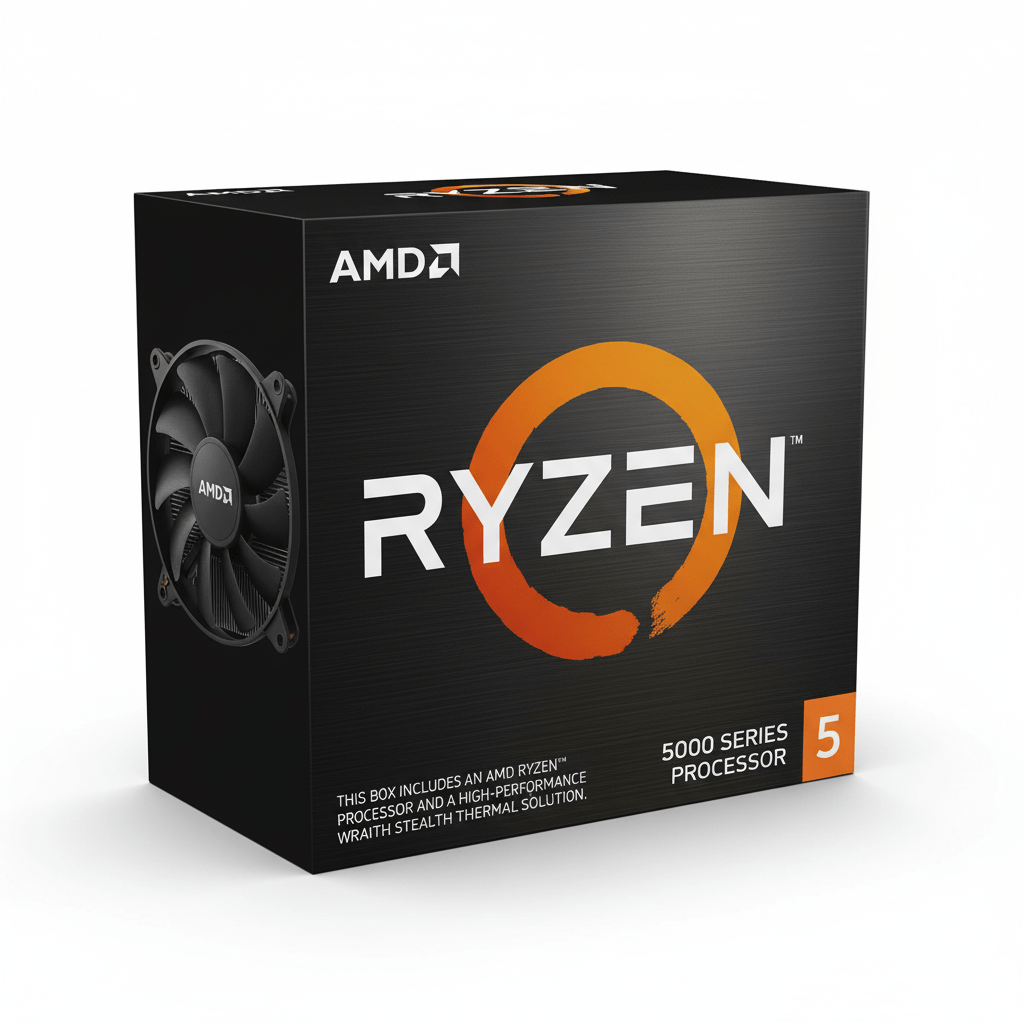
AMD Ryzen 5 5500 Review: 6-Core Powerhouse for Budget Builds
The AMD Ryzen 5 5500 is a capable mid-range desktop processor that punches above its weight for gaming and productivity on a budget, blending Zen 3 architecture with AM4 longevity. Released in 2022, it’s fueled by 6 cores and 12 threads at a 3.6 GHz base boosting to 4.2 GHz, backed by 19MB cache for snappy multitasking. Compatible with 500 Series chipsets, it supports PCIe 3.0 and DDR4 RAM. At 65W TDP, it runs cool in compact builds. At ₹7,028, the Ryzen 5 5500 is the value king for upgraders and entry-level enthusiasts.
Boost Your Build on a Budget?
Secure the AMD Ryzen 5 5500 and unlock premium perks!
Free delivery | EMI from ₹341/month | Non-Returnable | 3 Year Warranty
1. Core Performance: Multitasking Mastery & Efficiency
Engineered for balanced workloads with Zen 3 prowess.
6-Core Zen 3 (12 Threads):
Simultaneous Multithreading enables 12 threads for seamless handling of multiple applications. Built on the efficient Zen 3 architecture with 7nm process, this hexa-core design delivers up to 19% IPC uplift over Zen 2, excelling in everyday tasks like web browsing, document editing, and moderate video rendering. While it shares roots with APUs like the 5600G, the focused core allocation ensures reliable performance in budget gaming rigs and productivity setups without integrated graphics distractions.
3.6 GHz Base / 4.2 GHz Boost:
Precision Boost 2 intelligently scales frequencies for optimal power use during intensive loads. With a solid 3.6 GHz base clock, it maintains consistent speeds for prolonged sessions like streaming or compiling code, while bursting to 4.2 GHz on single threads for quick responses in apps like Photoshop or web rendering. This dynamic adjustment keeps thermals in check under the 65W envelope, providing a balanced experience for users upgrading from older quad-core systems in 2025.
19MB Unified Cache:
16MB L3 + 3MB L2 setup reduces memory latency for faster data retrieval in cache-sensitive tasks. The unified design shares resources across cores, boosting performance in multi-threaded workloads such as video encoding or 3D modeling by up to 10-15% compared to previous generations with less cache. Derived from APU silicon, this configuration prioritizes core efficiency over graphics, making it ideal for discrete GPU builds where quick cache hits enhance overall system responsiveness.
2. Platform Compatibility & Thermal Efficiency
Seamless integration with legacy AM4 ecosystems.
AM4 Socket / 500 Series:
Broad Motherboard Support including B450, B550, and X570 with a simple BIOS flash. This compatibility allows easy drop-in upgrades for existing AM4 users, extending the life of DDR4-based systems without a full platform swap in 2025. Paired with robust VRM designs on these boards, it ensures stable operation under load, making it a cost-effective choice for builders avoiding the AM5 transition.
65W TDP Efficiency:
Low-Power Design with max temps at 95°C, compatible with stock Wraith Stealth cooler for quiet operation. This TDP rating allows sustained boosts without excessive heat, ideal for small form-factor cases or energy-conscious builds where power bills matter. In real-world gaming and productivity, it draws under 80W peak, providing headroom for mild overclocking while keeping fans minimal.
PCIe 3.0 / DDR4 Support:
20 PCIe Lanes for GPUs and storage, supporting DDR4-3200 up to 128GB in dual-channel mode. This setup delivers bandwidth for mid-range graphics cards like RX 6700 XT, ensuring smooth 1440p gaming without bottlenecks in most titles. While PCIe 3.0 limits top-end SSD speeds compared to Gen 4, it remains sufficient for budget NVMe drives, keeping costs low for AM4 loyalists.
Unlocked for Tweaks:
Precision Boost Overdrive and full multiplier unlock allow safe overclocking for extra performance gains. Users can push beyond 4.2 GHz with adequate cooling, yielding 5-10% uplifts in multi-threaded benchmarks like Cinebench. This feature, combined with AMD’s Ryzen Master software, makes it accessible for enthusiasts tuning on a budget without voiding the 3-year warranty.
3. Build Integration & Value Ecosystem
Effortless fit in diverse PC configurations.
Compact 65W Design:
40 x 40 mm Die with included Wraith Stealth cooler for immediate installation in any ATX or micro-ATX case. The small footprint and low heat output make it perfect for space-constrained builds, running under 70°C during extended sessions with basic airflow. This efficiency supports quiet operation in home offices or media centers, minimizing the need for premium cooling solutions.
Integrated Graphics Free:
No Onboard iGPU requires a discrete card, but frees up die space for better core yields and cache focus. This design excels when paired with affordable GPUs like GTX 1660 or RX 6600, delivering strong 1080p performance without the overhead of integrated silicon. For builders prioritizing raw CPU power on a budget, it avoids the compromises seen in APU variants, ensuring dedicated graphics shine.
AM4 Legacy Support:
Extended Platform Life through BIOS compatibility with 300/400/500 series boards for affordable refreshes. This backward support maximizes investment in existing DDR4 RAM and cases, allowing users to achieve modern Zen 3 performance without scrapping hardware. In 2025, it remains a bridge for those delaying AM5 adoption, offering PCIe 3.0 stability for current GPUs and storage.
Pros and Cons
Balanced view for value-driven mid-range performance in 2025.
Pros
- Budget Power: ₹7,028 for 6-core Zen 3.
- Multithreading: 12 threads for smooth multitasking.
- AM4 Compatibility: Easy upgrades on existing boards.
- Efficient TDP: 65W for cool, quiet operation.
- Overclockable: Unlocked with PBO for tweaks.
- 3-Year Warranty: Reliable long-term support.
Cons
- No iGPU: Requires discrete graphics card.
- PCIe 3.0 Only: Limits newer storage/GPU speeds.
- Less Cache: 16MB L3 vs 32MB in higher models.
- AM4 End: No path to DDR5 or AM5.
- Non-Returnable: Verify compatibility beforehand.
- BIOS Update Needed: For older 300/400 series boards.
Who Is This Processor For? Tailored Recommendations
The Ryzen 5 5500 suits:
- Budget Gamer: 1080p players wanting 6-core smoothness under ₹10K.
- AM4 Upgrader: Legacy board owners seeking Zen 3 refresh.
- Productivity User: Multitaskers needing efficient 65W operation.
Who Might Consider Other Options?
- High-End Creator: 6 cores fine for basics, but lacks 8+ core grunt.
- AM5 Newbie: AM4 limits future, missing DDR5/PCIe 5.0.
- Integrated Graphics Fan: No iGPU requires dedicated card.
Competitive Edge: What Sets It Apart
Superior threading for its era at a budget price.
- Vs Ryzen 5 5600: Affordable alternative with similar cores but lower cost.
- Vs Intel i5-11400: Better multi-thread value on AM4.
- Value Proposition: 67% off MSRP for reliable performance.
- Zen 3 Efficiency: IPC edge over Zen 2 budget chips.
Full Specification Details
General Information
- Price (Starting): ₹7,028
- Model: Ryzen 5 5500
- Architecture: Zen 3
- Launch Date: Q2 2022
Processor & Cache
- Cores/Threads: 6 / 12
- Base/Boost Clock: 3.6 GHz / Up to 4.2 GHz
- Cache: 19 MB Unified (16MB L3)
Power & Thermal
- TDP: 65W
- Unlocked: Yes
- Max Temp: 95°C
Connectivity & Memory
- Socket: AM4
- Chipsets: 500 Series
- Memory: DDR4 Up to 128GB
- PCIe: 3.0
Graphics & Other
- iGPU: None
- Process: 7nm
- Warranty: 3 Years
- OS Support: Windows 10/11
Compatibility
- Motherboards: B450/B550/X570
- RAM: DDR4-3200 Up to 128GB
- USB: Via Motherboard (3.2 Gen 1)
Final Verdict
The AMD Ryzen 5 5500 delivers capable performance for budget desktops, ideal for AM4 upgrades but showing limits in cache-heavy tasks in 2025.
Great for mid-range value needs.